A kitchen without a pantry can feel like a losing battle. Every bag of rice, every spice jar, every pan needs a home — and in a small kitchen, there simply is not much home to go around. The good news is that a pantry is just a storage system, and you can build one yourself out of the space you already have. You do not need a remodel, a bigger kitchen, or expensive organizers. You need a clear plan, a few honest decisions about what stays, and storage that fits how you actually cook.
This guide walks through exactly how to organize a small kitchen with no pantry, step by step, so that everything you use has a place and everything you reach for is easy to find.
Start by Decluttering — Really Decluttering
No storage system can fix a kitchen that holds too much. Before buying a single bin or shelf, take everything out of your cabinets and drawers and sort it into three groups: keep, donate, and throw away. Be honest about duplicates — most small kitchens hide two or three spatulas, half-used spice jars, and gadgets that have not been touched in a year.
A useful rule: if you have not used it in the last six months and it is not seasonal (like a holiday baking tin), let it go. The space you free up is the cheapest storage you will ever get. If the whole-house declutter feels overwhelming, our room-by-room guide to decluttering your home breaks the same process down into small, manageable steps, kitchen included.
Create Zones Instead of Random Shelves
The single most effective change in a pantry-less kitchen is zoning: group everything by what you do with it, and store each group where you use it.
- Cooking zone: oils, salt, pepper, and your most-used spices beside the stove, plus pots, pans, and cooking utensils within arm’s reach.
- Prep zone: cutting boards, knives, mixing bowls, and measuring cups near the largest stretch of counter.
- Cleaning zone: dish soap, sponges, and towels under or beside the sink — never mixed in with food.
- Food storage zone: dry goods, canned food, and snacks in one cabinet or on one shelf, so you always know where food lives.
- Serving zone: plates, bowls, glasses, and mugs near the dishwasher or drying rack, so putting things away takes seconds.
When every item has a zone, you stop hunting through random cabinets, and putting groceries away becomes automatic instead of a puzzle.
Use the Walls and Doors You Already Have
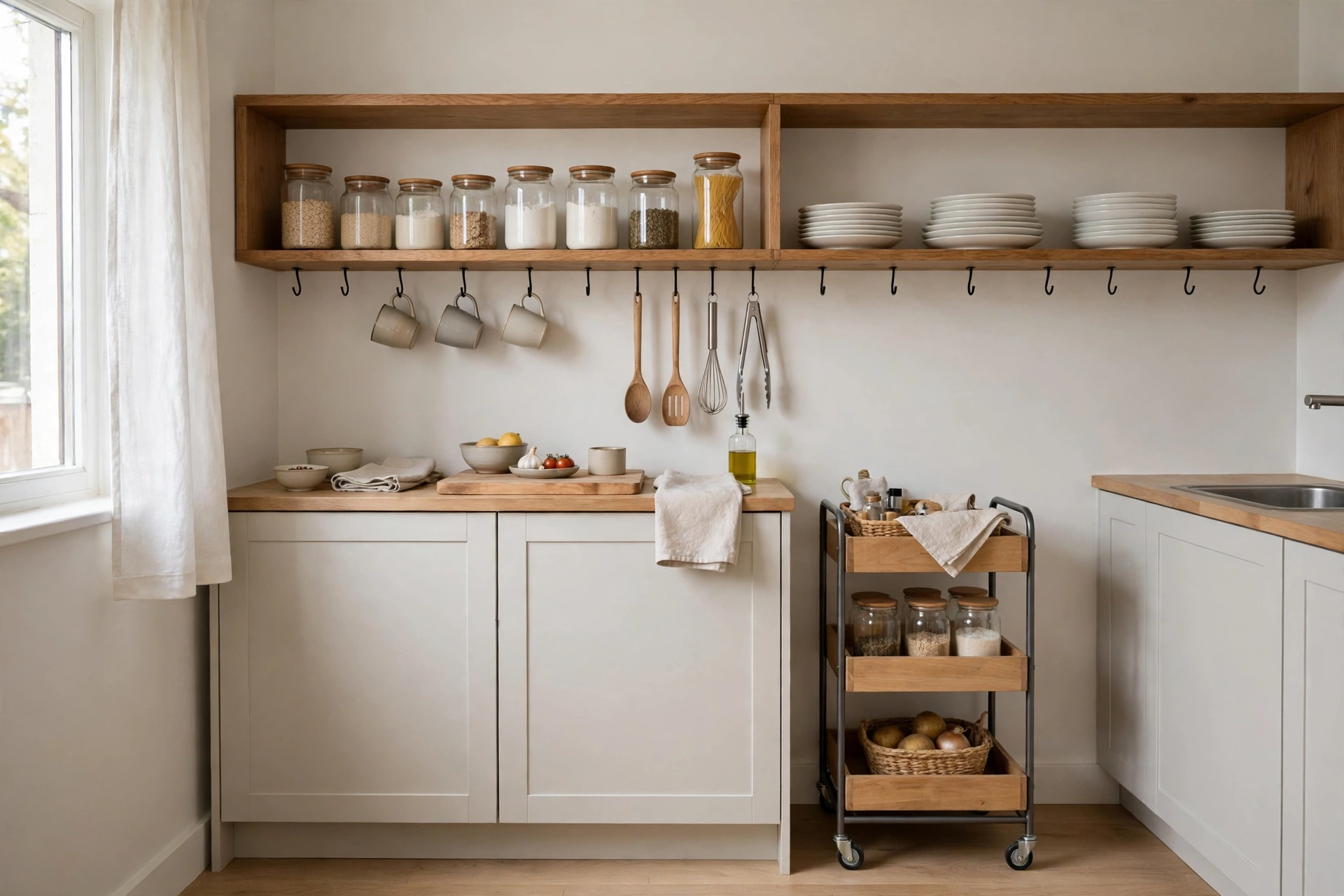
In a small kitchen, the walls are free real estate. A couple of open shelves above the counter can hold your everyday dishes and dry goods in jars — and because they are visible, you will actually use what is on them. Hooks under a shelf hold mugs and measuring cups. A rail with S-hooks beside the stove keeps spatulas, ladles, and tongs off the counter.
Do not forget the inside of cabinet doors. A slim rack on the inside of a door holds spice jars, foil, or cleaning supplies without taking a single inch of shelf space. The back of a door is also a good spot for a small chalkboard or a printed list of what is stored where — handy when more than one person cooks.
Build a Pantry Without a Pantry
You do not need a dedicated pantry room. You need one defined place where food lives, and a few containers that make it work.
- A rolling cart: a narrow three-tier cart fits in a gap beside the fridge or counter and rolls out when you need it. Use the top tier for daily items, the middle for baking supplies, and the bottom for heavier things like potatoes and onions.
- Clear, airtight jars: decant rice, pasta, flour, and sugar into matching clear jars. You can see at a glance what is running low, and the jars stack neatly where odd-shaped bags cannot.
- One “pantry” cabinet: pick a single cabinet and claim it as the pantry. Add a shelf riser or two so you get two levels out of one shelf, and keep the most-used items at eye level.
- Baskets and bins: a bin per category — snacks, baking, breakfast, canned goods — turns a deep cabinet into labeled sections instead of a dark pile.
The goal is simple: one place for food, with everything visible and reachable. If you have to move three things to reach the rice, the system is not working yet.
Keep the Counters Clear
Counter space is the scarcest resource in a small kitchen, and cluttered counters make the whole room feel smaller. Keep only what you use every single day on the counter — usually a kettle or coffee maker, a cutting board, and perhaps a knife block. Everything else goes away.
Appliances you use once a week or less — the blender, the food processor, the slow cooker — belong in a cabinet or on a high shelf, not on the counter. If an appliance is heavy and awkward to lift, store it at waist height so getting it out is easy. A clear counter also makes cooking faster, because you always have somewhere to set a chopping board down.
Store Things by How Often You Use Them
Once your zones are set, arrange each one by frequency. Daily items go between waist and eye level. Weekly items go on higher shelves or deeper in a cabinet. Rarely used items — the turkey roaster, the fondue set, the extra serving dishes — go on the very top shelf or even outside the kitchen if you have a hallway cupboard.
This one rule prevents the most common small-kitchen frustration: the everyday plates living on a high shelf while the once-a-year casserole dish sits at eye level. Reorganizing by frequency costs nothing and saves you reaching and bending every day.
Make Weekly Cooking Easier, Not Harder
A small kitchen rewards a simple weekly routine. When your dry goods, spices, and tools each have a fixed spot, cooking becomes faster — and planning meals gets easier too, because you can see what you actually have. If you want a routine that fits this setup, our guide to meal prep for beginners shows how to plan a week of meals and store them in a kitchen with limited space.
Keep a short running list — on the fridge or in your phone — of staples as they run out. In a kitchen without a pantry, you cannot rely on a big stockpile, so a small, steady shopping habit beats a monthly bulk buy that has nowhere to go.
Cheap Storage That Actually Works
You do not need a full container-store overhaul. A few low-cost pieces cover most small kitchens:
- Shelf risers and stackable shelves to double a cabinet’s usable height.
- A lazy Susan (turntable) in a deep corner cabinet so nothing gets lost at the back.
- Stackable bins or baskets to group small items by category.
- Adhesive hooks inside cabinet doors for measuring cups and lids.
- A tension rod under the sink to hang spray bottles and free up the floor of the cabinet.
Buy these after you have decluttered and zoned, not before — otherwise you end up organizing clutter instead of removing it.
Mistakes to Avoid
- Buying organizers before decluttering: containers cannot fix overcrowding; they just hide it more neatly.
- Hiding everyday items: if your coffee, salt, or cutting board is hard to reach, you will leave it on the counter anyway.
- Storing food in more than one place: scattered food means forgotten food, and forgotten food expires.
- Overfilling open shelves: open storage only works when it is tidy. Leave breathing room, or the shelves look cluttered instead of charming.
- Ignoring the fridge: the fridge is part of your storage system. Keep its shelves zoned the same way — drinks, dairy, leftovers, produce — so nothing hides at the back.
Frequently Asked Questions
Where do I store food if I have no pantry and no spare cabinet?
Use a rolling cart, a shelf above the counter, or a single deep drawer fitted with dividers. Even a small bookcase or a set of wall shelves in a nearby dining area can work as overflow food storage, as long as it is one defined place.
How do I keep a small kitchen organized long term?
Give everything a fixed home, put things back in that home after every use, and do a five-minute reset each evening. A quick monthly check — tossing expired items and returning stray things to their zones — stops clutter from creeping back.
Are open shelves a good idea in a small kitchen?
Yes, for items you use often, because they keep things visible and easy to grab. Keep the shelves limited to a few categories, use matching jars and containers, and avoid overloading them — a tidy shelf feels spacious, a crowded one feels messy.
The Bottom Line
Organizing a small kitchen with no pantry is less about buying storage and more about making decisions: what stays, where it lives, and what you reach for most. Declutter first, divide the kitchen into zones, use your walls and doors, and give food one clear home. Do that, and a small kitchen without a pantry can work just as well as one with it — sometimes better, because everything you own is visible, reachable, and actually used.