
Learning a new language as an adult can feel like starting a race long after everyone else has left the starting line. Children seem to absorb languages effortlessly, while you sit there struggling to remember whether the word for “thank you” comes before or after the verb. Here is the good news: adults are not worse learners, they are different learners. You already know how to study, how to set goals, and how to stick with something when it matters to you. Those are real advantages, and this guide shows you how to use them.
The goal of this article is simple: give you a realistic, practical plan for learning a new language as an adult beginner, without expensive courses, without moving abroad, and without spending hours a day. If you can give it 20 to 30 minutes a day, you can make steady, visible progress.
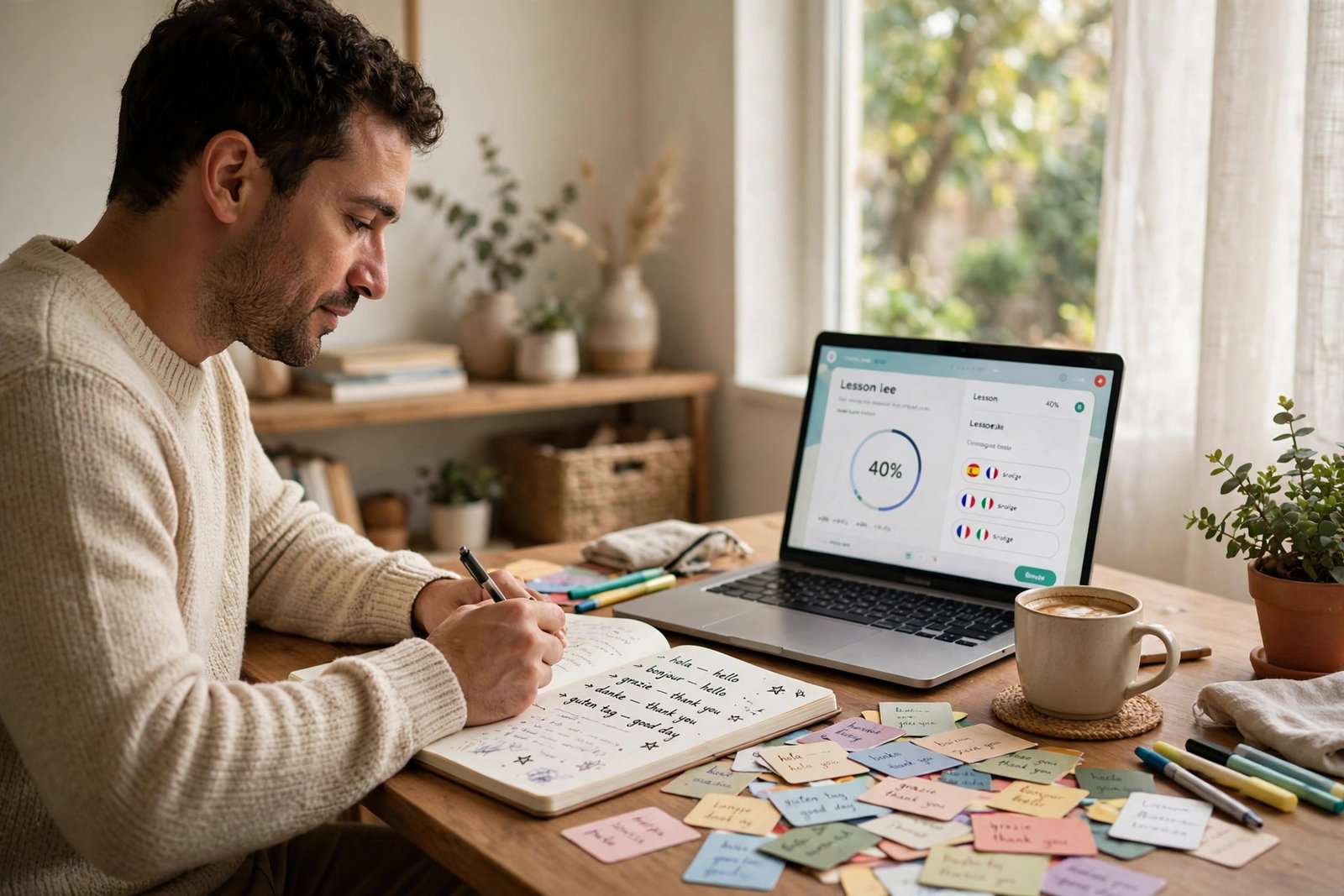
Pick the Right Language and a Clear Reason
Before you open a single app, decide two things: which language, and why. The “why” matters more than most beginners think, because motivation is what carries you through the flat weeks when progress feels slow.
Good reasons are concrete: you are planning a trip, your partner’s family speaks the language, it helps your career, or you simply love the culture and want to enjoy its films and books in the original. Vague reasons, like “it might be useful one day”, rarely survive the first month.
If you are torn between two languages, pick the one you have a real reason to use. A language you will actually speak, read, or hear regularly will always beat a language that only looks impressive on paper.
Set a Realistic Daily Routine
The single most important decision in language learning is not which app you use. It is how often you show up. Short, daily sessions beat long, occasional ones, because your brain needs repeated exposure to move new words from short-term memory into long-term memory.
A practical daily routine looks like this:
- 10 minutes of app or course lessons to learn new words and grammar in small steps.
- 10 minutes of review with flashcards, going over yesterday’s words before adding new ones.
- 5 to 10 minutes of listening or speaking, such as a short podcast, a song, or reading a few sentences aloud.
Attach the routine to something you already do every day, like your morning coffee or your evening wind-down. A habit tied to an existing routine is far easier to keep than one that depends on willpower alone. And if you miss a day, do not try to “make it up” with a two-hour session the next day. Just restart the next morning. Consistency over weeks is what builds a language, not heroic single days.
Learn Words You Will Actually Use
Many beginners waste weeks memorizing long lists of words they will never say. A smarter approach is to learn the most useful words first: greetings, numbers, common verbs like go, want, need, like and have, and the words for food, directions, time, and family.
Learn words in phrases, not in isolation. Remembering “I would like a coffee” is far more useful than memorizing the word for coffee on its own, because the phrase teaches you the sentence structure at the same time. When you learn a new word, write it in a sentence you might genuinely say.
Keep a small personal vocabulary list in a notebook or a notes app. Add five to ten words a day, and review them regularly. Spaced repetition, the idea of reviewing words just before you are about to forget them, is one of the most reliable study techniques there is. If you want to understand why it works, the same principle is explained in our guide to science-backed study tips that actually work.
Start Speaking Early, Even Badly
This is the step most adult beginners avoid, and it is the one that matters most. You do not need to be ready to speak. Speaking is how you get ready.
You do not need a native speaker sitting next to you to start. Talk to yourself: describe what you are doing while you cook, name the objects in your room, or practice ordering food out loud. Record yourself on your phone and listen back. It will feel awkward at first, and that is normal. The awkwardness fades quickly, and your pronunciation improves far faster when your mouth is actually forming the sounds.
When you are ready for real conversation, look for a language exchange partner or an affordable online tutor. Even one short conversation a week changes everything, because it forces you to use what you have learned under real conditions. Mistakes are not failures here; they are the fastest way to find out what you still need to learn.
Use Listening Every Day
Listening is the skill that makes everything else easier. If you can hear the sounds of a language clearly, you will pronounce it better, understand people faster, and pick up natural phrases without studying them.
Start with slow, beginner-friendly audio: graded podcasts, children’s stories, or the audio that comes with your course. Listen to the same short clip several times rather than rushing through new material. First listen for the general meaning, then listen again and try to catch individual words.
As you improve, add real content you enjoy: music, YouTube videos, TV shows with subtitles in the language you are learning. Enjoyment matters, because the listening you actually do is worth far more than the perfect listening plan you never start.
Choose Tools That Fit Your Life, Not the Other Way Around
There are more language apps and courses available now than ever before, and most of them are good enough. The best tool is the one you will open every day.
- An app for daily lessons and habit tracking. Pick one with a clear beginner path and stick with it for at least a month before judging it.
- A flashcard app for vocabulary review, using spaced repetition to bring words back at the right time.
- A dictionary app you can use quickly when you meet a new word in the wild.
- A notebook for writing down phrases, grammar notes, and your own example sentences. Writing by hand helps many people remember better than typing.
Resist the urge to collect five apps and three textbooks before you begin. One course, one flashcard system, and one way to practise speaking is a complete toolkit. You can add more later, once the habit is solid.
Common Mistakes Adult Beginners Make
Adults bring experience to language learning, but also a few habits that slow them down. Watch out for these:
- Waiting until you feel ready to speak. You never will. Speak from week one.
- Studying grammar before vocabulary. Grammar is important, but you need words to use it on. Learn grammar in small pieces, tied to sentences you actually want to say.
- Comparing yourself to children or to fluent speakers. Children have thousands of hours of immersion you do not have. Compare yourself to last month’s version of you instead.
- Skipping review. Learning a new word once is not learning it. If you never review, you will keep relearning the same words forever.
- Setting an all-or-nothing goal. “Fluent in three months” is a recipe for quitting. “Thirty minutes a day for three months” is a plan you can actually follow.
A Simple Four-Week Starter Plan
If you want a concrete starting point, here is a four-week plan for a complete beginner:
Week 1: Foundations. Learn greetings, introductions, numbers 1 to 20, and the most common verbs. Set up your app, your flashcard deck, and your daily 20-minute slot.
Week 2: Everyday survival. Learn the words for food, directions, time, and simple questions. Practise short dialogues out loud, such as ordering in a cafe or asking where something is.
Week 3: Start listening and speaking. Add a short daily listening habit and your first real conversation, even if it is just a five-minute exchange with a tutor or language partner.
Week 4: Build the habit. Review everything, notice what you can now understand that was impossible a month ago, and set your goal for the next month. The first month is about proving to yourself that the routine works. After that, you simply keep going.
Frequently Asked Questions
How long does it take an adult to learn a new language?
It depends on the language, how similar it is to your own, and how much time you practise each day. With 20 to 30 minutes of daily study, most adult beginners can hold simple conversations about everyday topics within a few months. Reaching comfortable fluency takes longer, usually a year or more of steady practice. The honest answer is that it takes as long as it takes, and the people who succeed are the ones who keep going past the point where it stops feeling new.
Am I too old to learn a language?
No. Adults learn languages successfully at every age. Research on language learning consistently shows that while children may pick up pronunciation more easily, adults are often faster at the early stages because they can use study strategies, understand grammar explanations, and draw on knowledge of their first language. Age is not the barrier. Irregular practice is.
Do I need to live in another country to become fluent?
Living abroad helps, but it is not required. With online tutors, podcasts, films, books, and language exchange partners, you can create a large amount of exposure from home. What matters is regular contact with the real language, not your postcode.
Should I learn the grammar first or the vocabulary first?
Learn them together, with vocabulary slightly ahead. You need enough words to form sentences, and just enough grammar to put those sentences together. Study a small grammar point, then immediately use it with words you already know. Grammar learned without practice fades fast; grammar learned through use sticks.
Final Thoughts
Learning a new language as an adult beginner is not about talent or age. It is about a small daily habit, words you will actually use, and the courage to speak before you feel ready. Pick your language, set your reason, and start with twenty minutes today. A year from now, you will be glad you started. And remember that rest is part of learning too: sleep is when your brain consolidates what you studied, so keeping regular sleep hygiene habits for better rest will help the words you learn today still be there tomorrow.