
Open your closet and count: how many pieces do you actually wear? For most people, 20 percent of the clothes get 80 percent of the wear, while the rest crowd the hangers, complicate every morning, and silently drain money. A capsule wardrobe flips that math — a small, intentional collection of versatile pieces that all work together.
Learning how to build a capsule wardrobe is not about owning as little as possible or dressing in beige forever. It is about keeping only what fits, flatters, and coordinates, so getting dressed takes five minutes and every outfit looks deliberate. This guide walks you through the full process, from the honest closet audit to the final curated list of pieces.
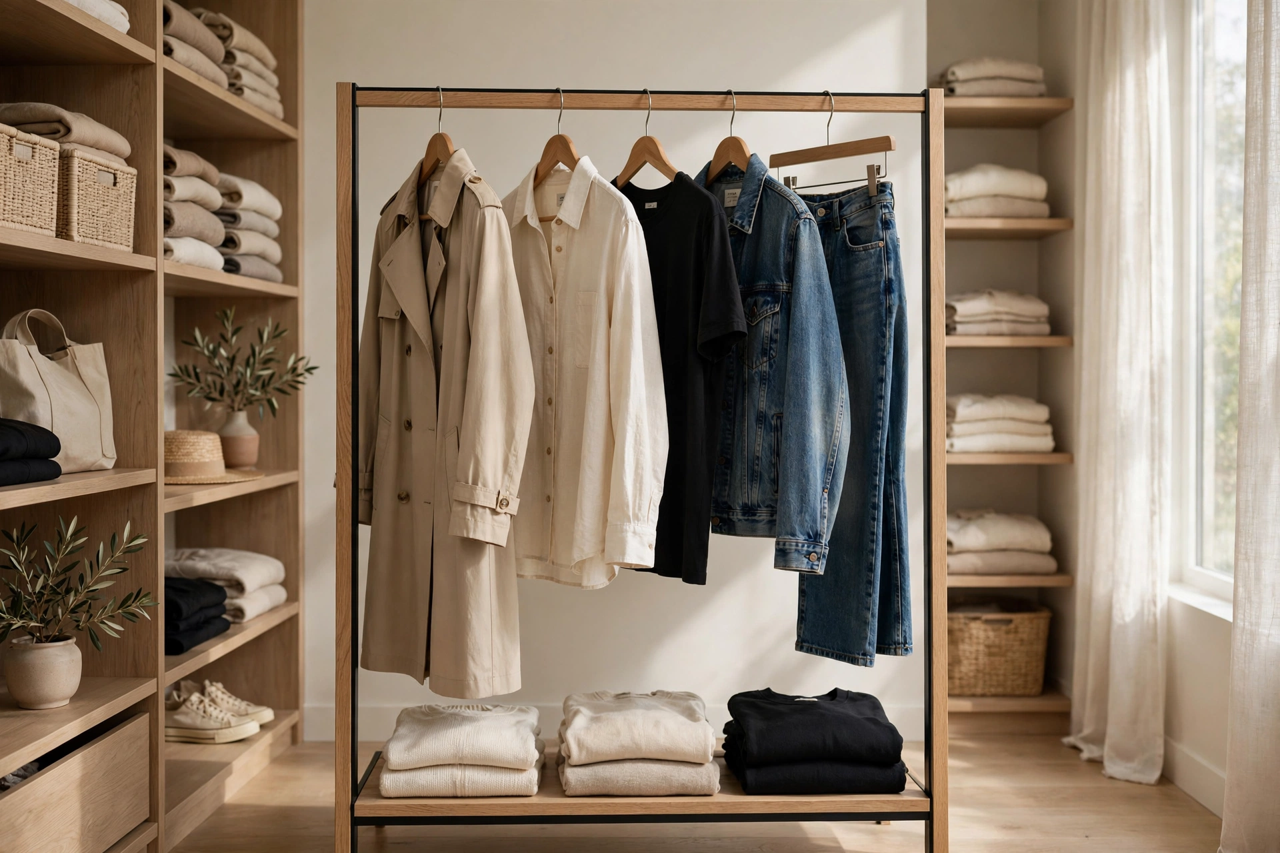
1. What a Capsule Wardrobe Actually Is
A capsule wardrobe is typically 30 to 40 pieces of clothing — including shoes and outerwear, but not underwear, gym gear, or sleepwear — chosen to mix and match freely. The idea, popularized by London boutique owner Susie Faux in the 1970s and revived by bloggers in the 2010s, is built on two principles: versatility and cohesion.
Versatility means every piece works in multiple outfits. A white shirt can go under a blazer, over jeans, or tucked into a skirt. Cohesion means your palette is limited enough that almost anything pairs with anything else. Three neutrals plus one or two accent colors is the classic formula.
It is not a uniform and it is not punishment. Color lovers can build a capsule around jewel tones; pattern lovers can anchor around stripes. The system flexes to your style — it just removes the pieces that never worked.
2. The Closet Audit: Be Ruthless but Honest
Start by emptying your closet completely — every hanger, every drawer. The pile on the bed is always shocking, and that shock is useful. Now sort every item into three groups: love and wear regularly, maybe, and never wear.
For the “maybe” pile, ask four questions. Does it fit right now? Would I buy it again today? Have I worn it in the last 12 months? Does it match at least three other things I own? A “no” to any two means it goes. Stained, stretched, or pilled items get donated or recycled regardless of sentiment — a capsule only works with pieces you would confidently wear tomorrow.
Box up the survivors you are not sure about and store them out of sight for a month. If you do not miss a single item, donate the box. You have just done the hardest part — and you can already see what your real style looks like in the keep pile.
3. Define Your Palette and Your Lifestyle
Look at your keep pile: which colors repeat? Those are your neutrals — most people land on some combination of black, white, navy, grey, beige, and denim. Add one or two accent colors you genuinely love and that suit your complexion. This limited palette is what makes 33 pieces feel like 100 outfits.
Then map your life. What percentage of your week is work, casual, social, formal? A capsule for someone who works in an office looks nothing like one for a work-from-home parent. Your pieces should match your actual life in those same proportions — three suits make no sense if you attend one formal event a year.
For style inspiration within a cohesive palette, current fashion trends can show you which silhouettes and accent colors are in play in 2026 — borrow the ideas, but only for pieces that fit your palette and lifestyle.
4. The Essential Pieces List (30–40 Items)
Here is a proven template to adapt. Tops: 2 white shirts, 2 neutral tees, 1 striped top, 1 silk or satin blouse, 2 sweaters (one chunky, one fine knit). Bottoms: dark jeans, black trousers, 1 skirt or pair of chinos, tailored shorts or light trousers depending on climate.
Layers: a blazer, a denim jacket or utility jacket, a trench or wool coat, a cardigan. Dresses/jumpsuits: one versatile dress that dresses up or down. Shoes: white sneakers, black flats or loafers, ankle boots, one dressy pair, sandals in warm climates. Accessories: a structured bag, a casual tote, a belt, a scarf, minimal jewelry you wear daily.
Fit matters more than brand. A $30 shirt tailored for $15 beats a $200 shirt that gaps at the buttons. When filling gaps in your list, buy slowly — one or two quality pieces a month — and shop online safely by checking sizing charts, return policies, and seller reviews before ordering wardrobe staples you cannot try on first.
5. Maintain It: The One-In-One-Out Rule
A capsule decays without maintenance. The one-in-one-out rule keeps it stable: every new purchase means one old piece leaves. This single habit stops the slow creep back to a stuffed closet and makes you deliberate about every addition.
Do a seasonal review — spring and autumn are natural moments. Pull everything out, check for wear, confirm each piece still fits your life, and refresh accent colors if your taste has shifted. Store the off-season coat or two if your climate demands it, but do not keep a “someday” section; someday clothes are clutter with a story.
Finally, track cost-per-wear for a month. A $120 pair of boots worn 60 times costs $2 per wear; a $40 top worn twice costs $20 per wear. That math quietly converts you into a quality-over-quantity buyer for life.
Conclusion and Quick FAQ
A capsule wardrobe is freedom disguised as limitation. Thirty-some pieces that all work together mean faster mornings, less spending, and — counterintuitively — more outfit variety than a closet three times the size. Audit ruthlessly, define your palette, build slowly, and maintain with the one-in-one-out rule.
How many pieces should a capsule wardrobe have? The classic target is 33 to 40 pieces including shoes and outerwear, excluding underwear, workout gear, and sleepwear. Adjust to your climate and lifestyle.
Is a capsule wardrobe expensive to build? Not necessarily. Most people already own 60 to 70 percent of their capsule; you only buy to fill gaps. Buying fewer, better pieces usually costs less over a year than constant fast-fashion shopping.
Can I still follow fashion trends with a capsule wardrobe? Yes — use your accent color and accessories to nod to trends. A trendy scarf or shoe updates the whole capsule without destabilizing it.