
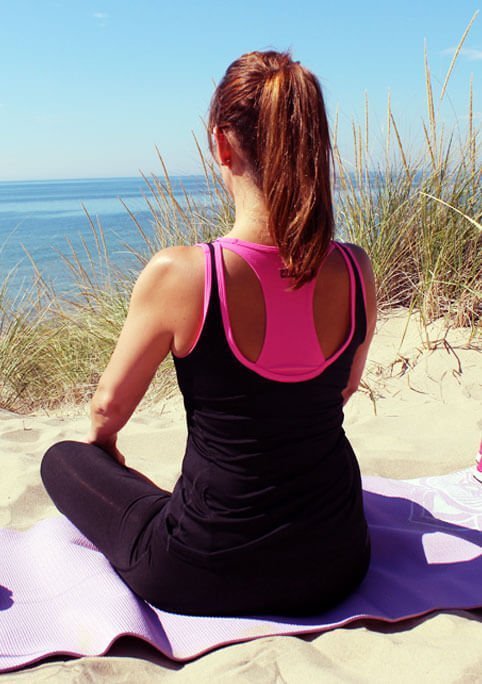
Nearly two thousand years ago, the sage Patanjali opened his Yoga Sutras with a definition so compact it still stops readers cold: “Yoga is the stilling of the changing states of the mind.” Not the poses. Not the flexibility. Not the workout. The stilling of the mind. If you have ever sat down to meditate only to find your thoughts racing louder than ever, you already understand exactly what he was talking about — and why yoga for a calm mind is a practice, not a purchase.
This guide unpacks what that ancient definition means for a modern beginner, and gives you a practical path — breath, movement, and a simple daily routine — to start experiencing a quieter mind yourself.
What “Stilling the Mind” Actually Means
In Sanskrit, the phrase is chitta vritti nirodha: chitta is the mind or consciousness, vrittis are its fluctuations — the thoughts, memories, worries, and fantasies that ripple across it constantly — and nirodha is their stilling or quieting. Patanjali’s insight was that we are not our thoughts; we are the awareness beneath them. Yoga, in its original sense, is the set of practices that lets you experience that distinction directly.
For a deeper exploration of the philosophy behind these words, it is worth reading the deeper meaning of this ancient definition — but you do not need to master the philosophy to benefit from the practice. You only need to start where you are, with the noisy mind you have.
Why Your Mind Won’t Stop Racing
Modern life is a vritti factory. Notifications, deadlines, news cycles, and social comparison keep your nervous system in a low-grade state of alert from morning to night. Your mind races not because something is wrong with you, but because it is doing its job — scanning for threats and opportunities in an environment that never powers down.
This is why “just relax” is useless advice. You cannot command a busy mind to be quiet any more than you can command a shaken snow globe to settle. You have to change the conditions — slow the body, deepen the breath, give attention a single gentle anchor — and let stillness arrive on its own.
Breath First: The Fastest Path to Calm
If you take one thing from this article, take this: the breath is the remote control for your nervous system. Slow, extended exhales activate the parasympathetic “rest and digest” response, measurably lowering heart rate and cortisol within minutes. It is the fastest legal way to calm down that exists.
Start with diaphragmatic breathing: sit comfortably, place one hand on your belly, and breathe so the belly rises on the inhale and falls on the exhale — five slow breaths. Then try box breathing: inhale for four counts, hold for four, exhale for four, hold for four, for two minutes. When that feels natural, explore nadi shodhana (alternate nostril breathing), a classic yogic technique for balancing mental energy. Five minutes of conscious breathing before bed will change your sleep within a week.
Poses That Quiet the Mind
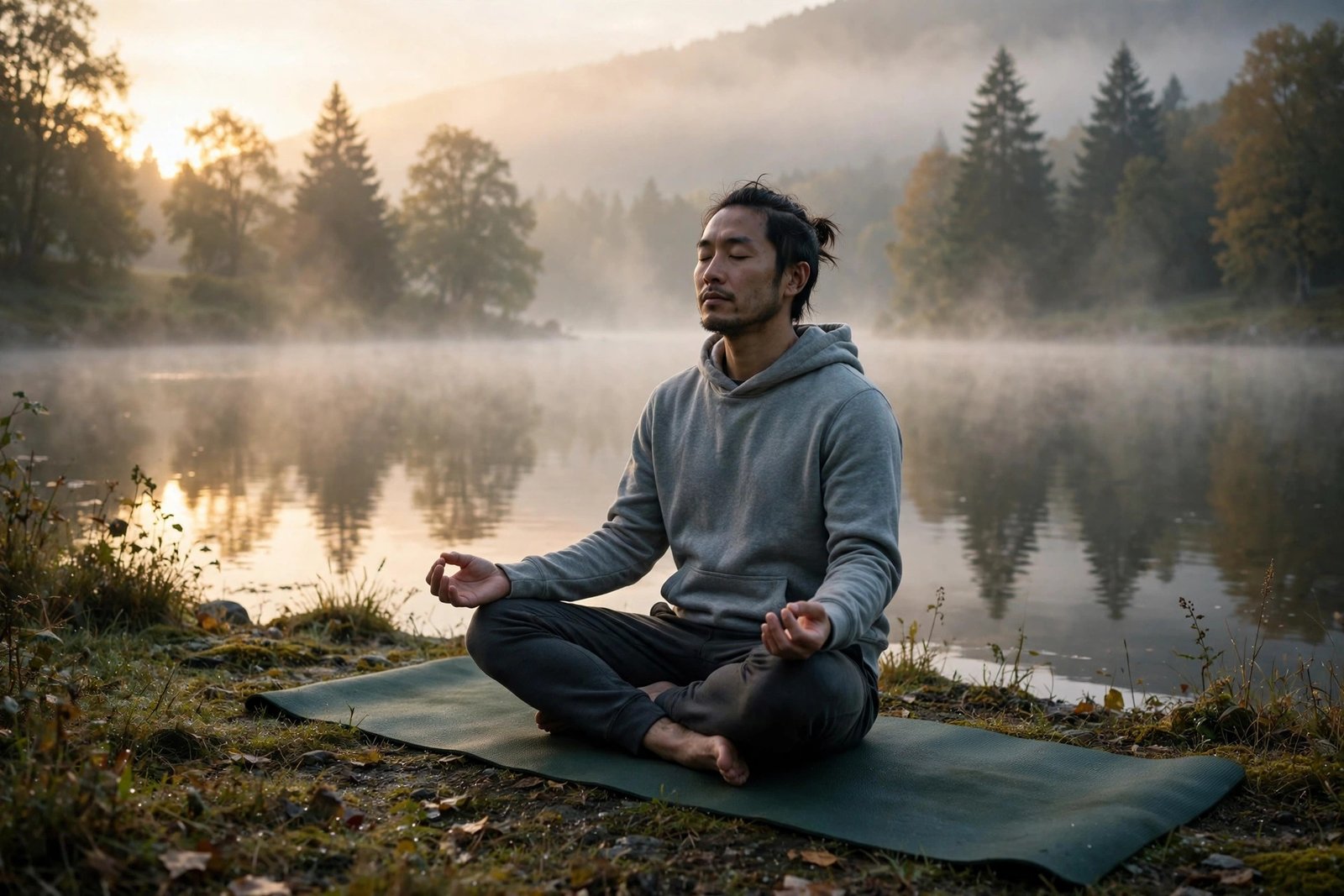
The physical poses of yoga (asanas) were originally designed for one purpose: to prepare the body to sit still comfortably. For a calm mind, favor slow, inward-focused poses over vigorous flows. Child’s pose, with the forehead resting on the ground, is deeply soothing to the nervous system. Standing forward folds let the head hang below the heart, which naturally quiets mental chatter. Legs-up-the-wall pose for five minutes in the evening is one of the most effective stress-relief tools in all of yoga.
Move slowly and breathe with every movement. The goal is not a workout — it is to give your attention something simple and physical to rest on, so the mental noise fades into the background. End every session with savasana (lying still for three to five minutes); it is not laziness, it is the pose where the stillness you have been cultivating gets to settle in. Pairing movement with daily mindfulness practices multiplies the benefits of both.
A Simple 15-Minute Daily Practice
You do not need an hour. Try this: minutes 1–3, sit and breathe diaphragmatically. Minutes 4–8, move gently through child’s pose, cat-cow, a standing forward fold, and a simple twist on each side, one breath per movement. Minutes 9–12, legs up the wall with slow box breathing. Minutes 13–15, savasana — lying still, doing nothing, letting the mind be as quiet as it wants to be. Done daily, this fifteen minutes will do more for your mental state than most weekend wellness retreats.
Mistakes Beginners Make
Three traps to avoid. First, chasing flexibility: forcing your body into deep poses creates tension, the opposite of stillness. Second, skipping the breath: if you are holding your breath, you are exercising, not practicing yoga. Third, comparing yourself to others — in class or online. Someone else’s practice has nothing to do with the state of your mind. And remember that choosing movement over medicine cabinets is a long game; the calm compounds over months, not days.
The Bottom Line
Patanjali was not describing a fitness goal. He was pointing at the quiet awareness underneath your busiest thoughts — and promising that with practice, you can rest there. Start with the breath, move gently, sit still for a few minutes a day. The changing states of the mind will not disappear, but they will stop running the show. That is yoga.