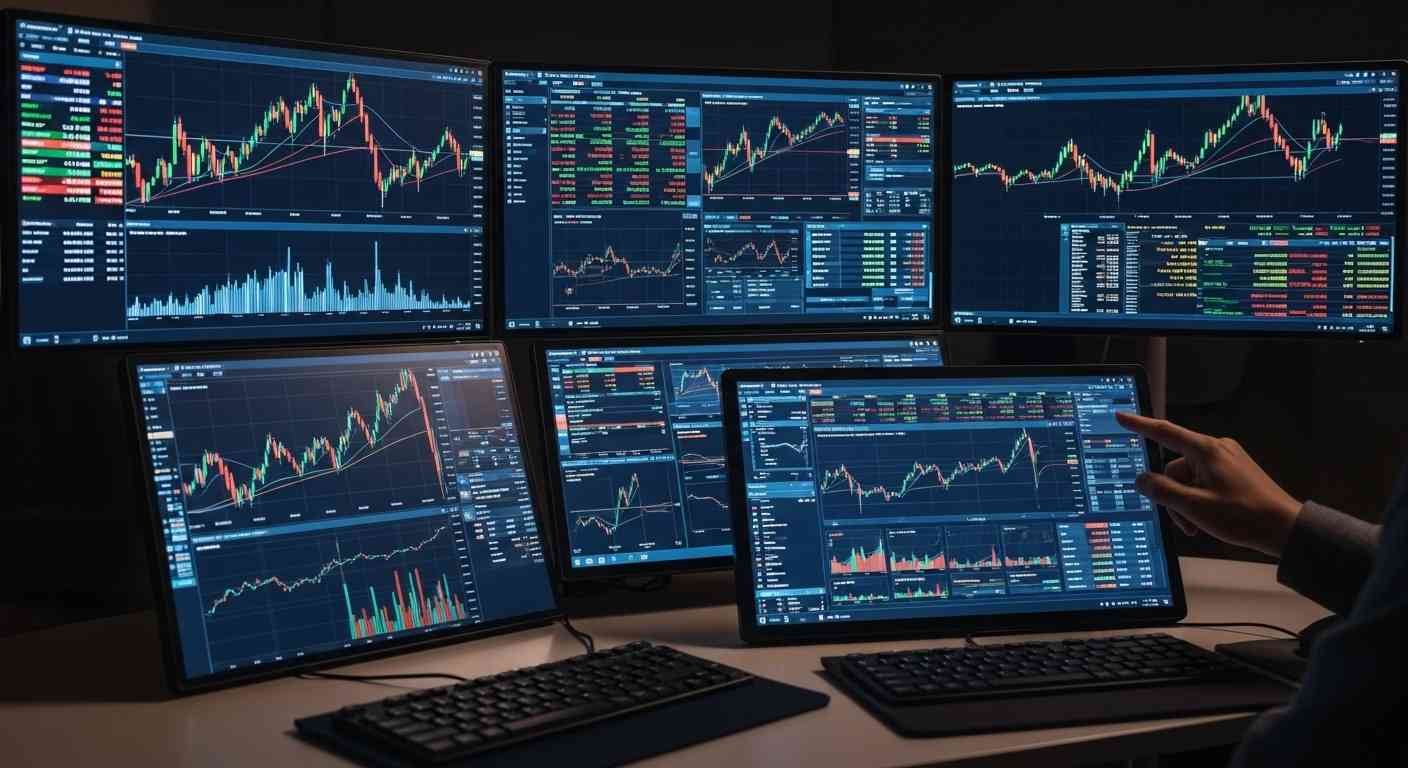
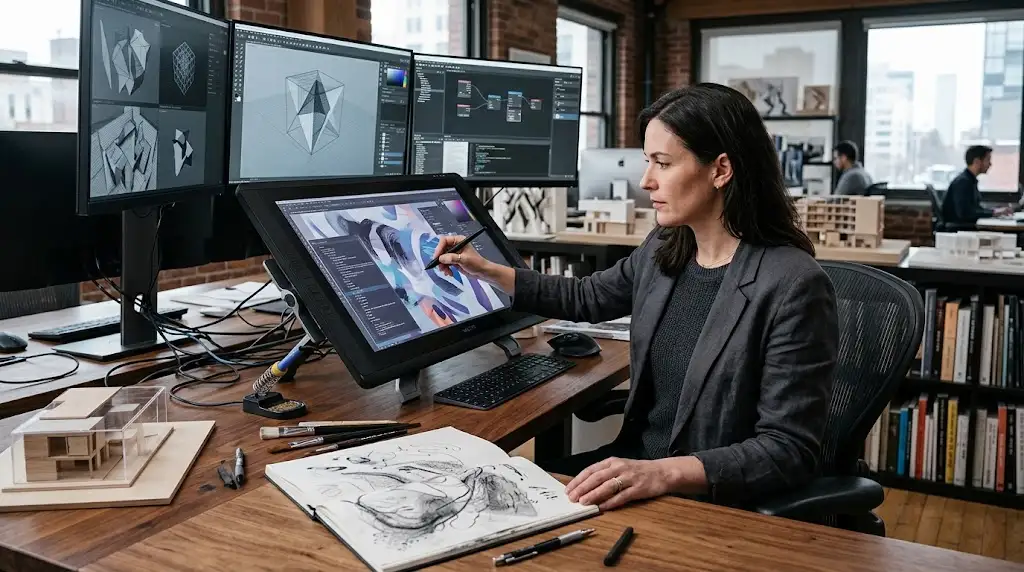
Technology and art may appear to belong to different worlds, but both begin with the same human ability: imagination. An artist imagines something that does not yet exist and gives it form through a chosen medium. An engineer or technologist does something remarkably similar by turning an idea into a product, system, experience, or tool.
That is why technology can be understood as a creative discipline rather than simply a collection of machines and software. From digital art and interactive installations to artificial intelligence, robotics, virtual environments, and advanced design tools, technology gives people new ways to explore ideas that once existed only in the mind.
The relationship between technology and creativity is not new. The tools available to artists have always influenced what they could create, while creative thinking has helped shape new technologies. Smithsonian Magazine has documented how technological developments have repeatedly opened new possibilities for artistic expression, from printing and photography to interactive and data-driven work.
Why Technology and Art Share the Same Creative Foundation
At their core, both art and technology involve a process of imagining possibilities, experimenting with ideas, making decisions, and transforming abstract concepts into something others can experience.
An artist might begin with a mental image, emotion, question, or story. A designer may begin with a problem that needs solving. An engineer may imagine a mechanism that could make something faster or more efficient. Although the outcomes differ, the creative process has important similarities.
MIT OpenCourseWare has even explored imagination and creativity across art, science, and technology as interconnected areas of human experience. This connection helps explain why innovation often requires more than technical knowledge: it requires the ability to envision alternatives.
Technology Gives Imagination New Materials
Every creative discipline depends partly on its tools. Painters work with pigments and surfaces. Sculptors work with physical materials. Photographers work with cameras and light. Digital creators can work with software, algorithms, sensors, simulations, artificial intelligence, and interactive systems.
Technology expands the creative toolbox.
A digital artist can manipulate an image without physically altering the original. A 3D designer can construct a virtual object before manufacturing it. An architect can explore an environment through computer-generated models. A musician can combine instruments, software, sampling, and electronic processing to create sounds that would be difficult to produce through traditional methods alone.
The tool does not replace imagination. Instead, it changes what imagination can become.
From Imagination to Innovation
One of the clearest connections between art and technology is the movement from an abstract idea to a tangible result.
Innovation rarely begins with a finished product. It begins with a possibility.
Someone imagines a better way to communicate, travel, work, create, learn, or solve a problem. That idea is then tested against practical limitations. Designers create concepts, engineers build prototypes, developers refine systems, and users provide feedback.
NASA has described imagination as an important part of moving from possible ideas toward design, testing, optimization, and innovation. The process demonstrates an important principle: imagination becomes particularly powerful when it is combined with experimentation.
Design Is Where Creativity and Technology Meet
Design provides one of the clearest bridges between technology and artistic thinking.
A successful digital product is not simply functional. It also needs to communicate clearly, respond to human behavior, and provide an experience that makes sense to its users.
That means designers have to think about structure, appearance, usability, emotion, accessibility, and purpose at the same time.
This is especially visible in digital user experience design, where technology and visual communication work together to make complex systems easier to understand and use.
The best design therefore sits somewhere between engineering and art. It uses technical constraints as boundaries while still leaving room for experimentation and originality.
Digital Art Shows How Technology Can Expand Expression
Digital art provides a direct example of technology becoming a creative medium.
Artists can now create interactive environments, generative visuals, immersive installations, animated works, projection-based experiences, and other forms that would be difficult or impossible using traditional materials alone.
Technology also makes it possible for an artwork to respond to its audience. Sensors can detect movement. Software can respond to sound. Algorithms can alter visuals in real time. Virtual environments can place viewers inside an experience rather than simply asking them to observe it.
These developments demonstrate that technology does not necessarily make art less human. In many cases, it gives artists another language through which to express human ideas.
Artificial Intelligence and the Changing Creative Process
Artificial intelligence has introduced another major development in the relationship between technology and creativity.
Generative AI systems can now assist with images, text, music, video, animation, and other creative outputs. MIT researchers have described generative AI as a new medium with distinctive possibilities for creative work while also highlighting important questions surrounding authorship, ownership, culture, and the future of creative professions.
The important question is therefore not simply whether machines can generate creative material. A more useful question is how people choose to work with these systems.
A person can use AI to explore variations, develop concepts, visualize possibilities, or overcome a creative block. The human still has to decide what matters, what communicates effectively, what should be rejected, and what direction the final work should take.
In that sense, technology can become a collaborator or instrument rather than an automatic replacement for human imagination.
Human Judgment Still Matters
Creative technology can produce impressive results, but output alone does not determine whether something is meaningful.
People interpret images, stories, products, interfaces, buildings, and experiences through cultural, emotional, and personal contexts. A technically impressive creation can still fail if it does not communicate a useful idea or connect with its intended audience.
This is one reason human judgment remains central to creative work.
Technology can generate possibilities at extraordinary speed. Humans provide context, intention, taste, ethics, and meaning.
Why Constraints Can Improve Creativity
It is tempting to assume that creativity becomes easier when technology removes every limitation. In practice, constraints can often make creative thinking stronger.
A designer working within a limited screen size has to prioritize information. An engineer working within a fixed budget has to make difficult choices. A filmmaker working with limited equipment may discover unconventional visual techniques.
Constraints encourage people to ask better questions:
- What is actually necessary?
- What can be simplified?
- What can be redesigned?
- What assumption should be challenged?
- How can limited resources produce a better result?
Creativity is therefore not simply about having unlimited options. It is often about finding an original path through limitations.
Technology Makes Experimentation Faster
Another major advantage of modern technology is the ability to experiment quickly.
A digital creator can test multiple layouts without rebuilding an entire physical object. A developer can prototype an interface and observe how users respond. An architect can modify a virtual model before construction. A filmmaker can experiment with visual effects during editing.
Rapid experimentation changes the creative process because failure becomes less expensive.
Instead of protecting one idea from criticism, creators can develop several possibilities, compare them, learn from weak results, and improve the strongest direction.
The Creative Partnership Between Humans and Technology
The most interesting future may not be one in which humans compete against technology, but one in which people use technology to extend their creative abilities.
MIT Press’s discussion of the relationship between humans and technology similarly emphasizes technology as a creative partnership rather than merely a mechanical tool.
This partnership can take many forms. A photographer can use computational tools to explore an image. An architect can use simulation to test an ambitious structure. A musician can experiment with digital instruments. A writer can use software to organize ideas. An artist can use generative systems to explore visual directions.
The technology provides capabilities. The human provides purpose.
What the Future of Creative Technology Could Look Like
As computing, artificial intelligence, robotics, extended reality, and digital fabrication continue to develop, the boundary between creator and tool will become increasingly fluid.
Future creative workflows may involve people describing an idea, machines generating multiple interpretations, designers refining the strongest concepts, and physical systems turning those concepts into real objects.
That possibility does not make human creativity less important. It makes creative judgment more important.
When technology can produce thousands of possibilities, the valuable skill becomes knowing which possibility deserves attention.
Technology Is Powerful Because People Imagine What Comes Next
The history of technology is ultimately a history of people refusing to accept the limits of what already exists.
Someone imagines a different tool. Someone else asks whether communication could happen faster. Another person wonders whether a machine could perform a task that currently requires human effort. Designers imagine better experiences. Artists imagine new forms of expression.
Technology turns some of those ideas into reality.
That is why the comparison between technology and art is so compelling. Both are expressions of the human desire to create something that did not exist before.
From traditional craftsmanship to digital design, artificial intelligence, robotics, and immersive media, the tools continue to change. The fundamental creative impulse remains remarkably consistent.
Technology becomes most transformative when human imagination gives it direction.
In the end, the most important innovation may not be the machine itself. It may be the idea that inspired someone to build it.