
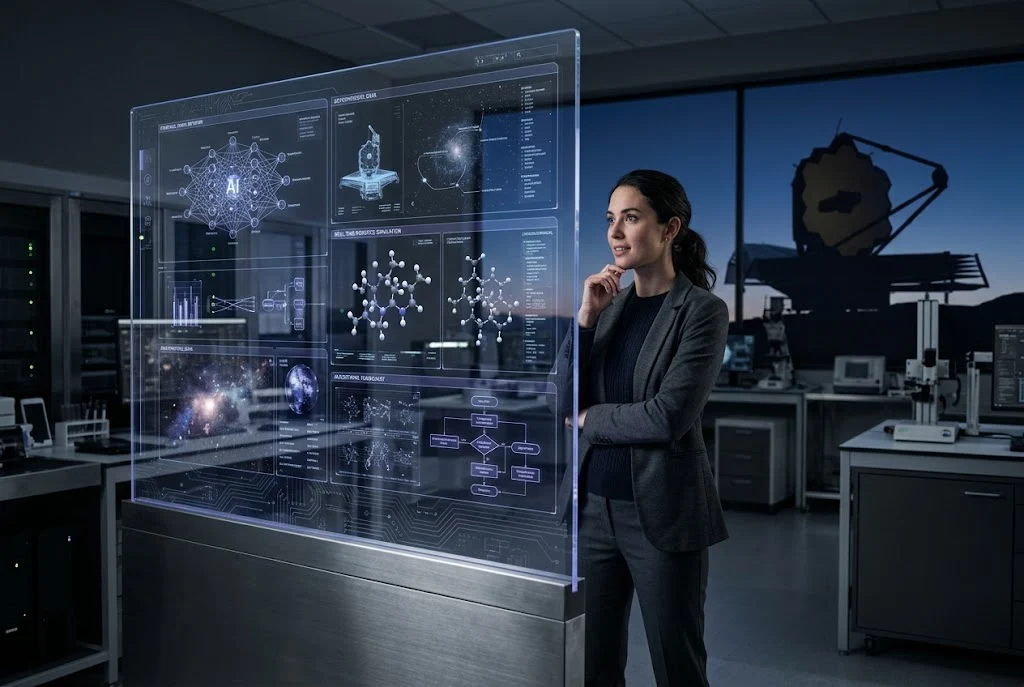
“Any sufficiently advanced technology is indistinguishable from magic” is one of Arthur C. Clarke’s most famous observations about technology, innovation, and human understanding. The quote suggests that when technology becomes advanced enough, people who do not understand the underlying science may experience its capabilities as something almost magical.
Today, the idea feels more relevant than ever. Artificial intelligence can generate text and images, smartphones can translate conversations in real time, satellites can provide navigation from space, and advanced telescopes can observe objects billions of light-years away. None of these technologies is supernatural, but their capabilities can seem extraordinary when the engineering behind them is hidden from view.
In this guide, we explain the meaning of “any sufficiently advanced technology is indistinguishable from magic,” its connection to Arthur C. Clarke, and why the principle still matters in an age of artificial intelligence, automation, space technology, and rapid digital innovation.
What Does “Any Sufficiently Advanced Technology Is Indistinguishable From Magic” Mean?
The quote means that technology can become so advanced that its results may appear impossible or magical to someone who does not understand how the system works.
Consider a smartphone. A single device can communicate with people across the world, identify locations, translate languages, record high-quality video, access enormous amounts of information, and run sophisticated software. For someone living hundreds of years ago, these capabilities would have been almost impossible to explain using the scientific knowledge available at the time.
For modern users, however, these functions are ordinary. We understand at least the basic idea that they depend on computing, wireless communication, software, sensors, satellites, and internet infrastructure.
The “magic” therefore comes from the gap between what technology can do and what the observer understands about how it works.
Who Said “Any Sufficiently Advanced Technology Is Indistinguishable From Magic”?
The quote is attributed to Arthur C. Clarke, the British science-fiction writer, futurist, and technology thinker. The Arthur C. Clarke Institute for Space Science Education lists the statement among Clarke’s notable quotations. :contentReference[oaicite:1]{index=1}
The statement is widely known as Clarke’s Third Law. It is associated with Clarke’s discussion of technological possibility in Profiles of the Future, where he explored how humanity thinks about scientific progress and the limits of what may eventually become possible.
Clarke’s observation became influential because it captures an important feature of technological progress: today’s extraordinary invention can eventually become tomorrow’s ordinary household tool.
Clarke’s Three Laws of Technology and Possibility
Clarke’s Third Law becomes easier to understand when considered alongside his other observations about scientific possibility.
Clarke’s First Law
Clarke’s First Law challenges the assumption that experts can always identify the limits of what is possible. It encourages people to be cautious when declaring something impossible simply because existing technology cannot accomplish it.
Clarke’s Second Law
His Second Law focuses on discovering the boundaries of possibility by pushing beyond established assumptions. In other words, progress often requires experimentation at the edge of what is currently achievable.
Clarke’s Third Law
The Third Law is the most famous: “Any sufficiently advanced technology is indistinguishable from magic.”
Together, these ideas form a broader message about technological innovation. The limits of today’s technology should not automatically be treated as the permanent limits of tomorrow’s technology.
Why Advanced Technology Can Look Like Magic
Advanced technology can appear magical for several reasons, even when its operation is based entirely on science and engineering.
Complexity Is Hidden From the User
Modern products are designed to hide complicated processes behind simple interfaces. A person may press one button and receive an answer in seconds without seeing the servers, algorithms, databases, networks, or hardware involved.
This makes advanced technology feel effortless while concealing the enormous amount of engineering required to make it work.
Technology Combines Multiple Scientific Fields
The most impressive modern technologies rarely depend on a single scientific discipline. They may combine mathematics, computer science, electronics, materials science, telecommunications, mechanical engineering, and artificial intelligence.
When all of these systems work together, the final result can appear much simpler than the technology underneath it.
Human Knowledge Is Specialized
No individual can fully understand every technology used in modern life. A software engineer may understand algorithms deeply but know little about satellite propulsion. A physicist may understand advanced materials while having limited knowledge of cybersecurity.
Modern society therefore depends on highly specialized knowledge distributed among millions of people.
Modern Examples of Technology That Can Feel Like Magic
Clarke’s Third Law becomes particularly easy to understand when applied to technologies people use today.
Artificial Intelligence
Artificial intelligence is one of the clearest modern examples. AI systems can process large amounts of information and produce predictions, recommendations, or decisions based on defined objectives. The National Institute of Standards and Technology (NIST) describes an AI system in similar terms, emphasizing machine-based systems capable of influencing real or virtual environments through predictions, recommendations, or decisions. :contentReference[oaicite:2]{index=2}
For a user, an AI system may appear to “understand” a question and produce a useful response almost instantly. Behind that interaction are models, computational systems, data processing, statistical methods, and software infrastructure.
The more capable these systems become, the easier it is for their output to feel mysterious to someone unfamiliar with the technology.
Smartphones
Smartphones combine computing, cameras, GPS, wireless communication, biometric sensors, cloud services, applications, and multimedia capabilities in a device that fits into a pocket.
The individual technologies involved are understandable, but their combination creates an experience that would have seemed extraordinary to earlier generations.
Satellite Navigation
Modern navigation systems can determine a device’s position and provide directions across cities, countries, and continents. Users generally interact with a map interface rather than the complex satellite, timing, signal-processing, and software infrastructure operating behind it.
That is another example of advanced technology becoming almost invisible while delivering an impressive result.
The James Webb Space Telescope
Space technology provides an even more dramatic example. NASA describes the James Webb Space Telescope as a highly complex infrared observatory using a large segmented mirror, a large sunshield, and four scientific instruments to study the universe. :contentReference[oaicite:3]{index=3}
Webb’s instruments can detect infrared wavelengths that human eyes cannot see directly. Its technology allows scientists to investigate extremely distant and faint objects, making the results of advanced engineering accessible through images and scientific data. :contentReference[oaicite:4]{index=4}
To a person unfamiliar with astronomy and optical engineering, the ability to observe such distant objects can understandably feel almost magical.
Technology Like Art Begins With Human Imagination
Advanced technology does not appear from nowhere. It usually begins with an idea, question, experiment, or creative vision.
That connection between technology and imagination is important because many innovations start as concepts that do not yet have a practical implementation. Designers and engineers must imagine a possibility before they can determine how to build it.
ZenithNote also explores this relationship in its article about how technology is an expression of human imagination. That perspective complements Clarke’s Third Law: what appears magical after completion may have started as nothing more than an ambitious idea.
From Imagination to Real-World Innovation
The journey from an idea to a working technology normally involves several stages.
- Concept: Someone identifies a possibility or imagines a new solution.
- Research: Scientists and engineers determine what principles could make the idea work.
- Experimentation: Prototypes and early systems are developed and tested.
- Engineering: The technology is refined for reliability, performance, safety, and scalability.
- Deployment: The finished system becomes available for practical use.
- Normalization: Once the technology becomes common, people stop thinking of it as extraordinary.
This final stage is particularly interesting. The technology may remain extremely sophisticated, but familiarity changes how people perceive it.
Why Technology Eventually Stops Feeling Magical
Consider electricity, computers, television, smartphones, or the internet. Each represented major technological breakthroughs when introduced or developed. Today, most people interact with them without thinking about the science involved.
This happens because familiarity reduces mystery.
When people understand the basic principles behind a technology, its results no longer seem supernatural. The technology becomes part of the normal environment.
In this sense, technological progress does not necessarily make the world less amazing. Instead, it moves the boundary of what people consider normal.
Technology Can Be Advanced Without Being Perfect
Clarke’s quote should not be interpreted as saying that advanced technology can do anything.
Technology still operates within physical, economic, computational, and engineering constraints. A sophisticated system can fail, produce incorrect results, require maintenance, or have limitations that users need to understand.
Artificial intelligence, for example, can produce impressive results while still making mistakes. Advanced automation can improve efficiency without eliminating every possible source of human error.
This distinction matters because technological sophistication should not automatically be confused with reliability or infallibility.
Why Understanding Technology Still Matters
Clarke’s observation can inspire wonder, but it should also encourage curiosity.
People do not need to become experts in every field, but basic technological literacy helps users understand what a system can do, what it cannot do, what information it requires, and what risks may be involved.
Understanding the basics also makes it easier to distinguish genuinely advanced technology from exaggerated marketing claims.
The more impressive technology becomes, the more important it is to ask sensible questions about how it works.
What Clarke’s Third Law Means for the Future
The principle remains relevant because technological development continues at a remarkable pace. Artificial intelligence, robotics, biotechnology, advanced computing, space exploration, automation, and new materials are all expanding the range of what technology can accomplish.
Some predictions will become reality. Others will fail because they are technically difficult, economically impractical, unsafe, or simply based on incorrect assumptions.
That uncertainty is part of innovation. The future cannot be understood only by extending today’s technology in a straight line.
Some of the most important breakthroughs may come from combinations of technologies that are currently developing separately.
The Deeper Lesson Behind the Quote
The deeper lesson of “Any sufficiently advanced technology is indistinguishable from magic” is not really about magic. It is about human perspective.
People judge what is possible based on their experience and knowledge. When a new technology exceeds those boundaries, it can initially seem impossible.
Eventually, however, people learn how it works, engineers improve it, manufacturers make it affordable, and society incorporates it into everyday life.
What once looked impossible becomes familiar.
That pattern has repeated throughout technological history, and there is little reason to believe it will stop.
Final Thoughts
Arthur C. Clarke’s famous statement remains one of the most useful ways to think about technological progress. Any sufficiently advanced technology is indistinguishable from magic because people can experience the results of a complex system without understanding everything happening underneath it.
Artificial intelligence, smartphones, satellite navigation, and space telescopes demonstrate how advanced engineering can produce capabilities that seem extraordinary from the outside. Yet these achievements are built through science, mathematics, experimentation, engineering, and human imagination.
The real lesson is simple: today’s ordinary technology may once have looked impossible, and tomorrow’s impossible idea may eventually become something we use every day.
For a broader look at the relationship between technological progress and imagination, explore technology and human imagination as part of the wider technology content cluster on ZenithNote.