
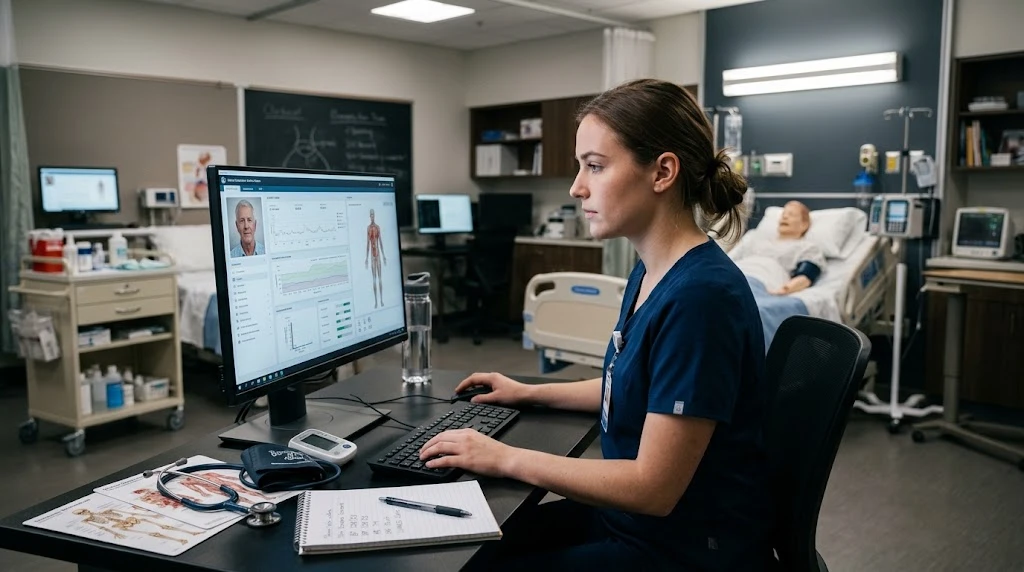
The Comprehensive Assessment is particularly useful because it brings several nursing skills together in one structured experience. Students must gather subjective information, perform objective assessments, organize their findings, document the encounter, and reflect on their clinical reasoning.
Elsevier describes Shadow Health Digital Clinical Experiences as high-fidelity, screen-based simulations that use Digital Standardized Patients to help nursing students develop patient-care and clinical-reasoning skills. The platform includes activities involving patient interviews, physical examinations, documentation, therapeutic communication, and clinical judgment.
What Is the Shadow Health Comprehensive Assessment?
The Shadow Health Comprehensive Assessment is a simulated clinical assignment centered on performing a complete health assessment. In the Health Assessment collection, the Comprehensive Assessment uses Tina Jones as the Digital Standardized Patient. Students conduct a comprehensive, head-to-toe assessment rather than concentrating on only one body system.
This makes the assignment different from a focused examination. A focused exam may concentrate on one presenting complaint or body system, while a comprehensive assessment requires students to organize a broader assessment sequence and collect information across multiple areas.
Shadow Health also includes a Plan My Exam activity for the Comprehensive Assessment. This allows students to practice organizing possible examination actions into a logical sequence before performing the simulated assessment.
How the Comprehensive Assessment Works
A comprehensive assessment generally combines several activities that mirror important parts of a clinical encounter. The exact activities available can depend on the assignment configuration and the instructor’s course settings.
1. Patient Interview
The interview is an important part of the assessment because students need to gather subjective information directly from the simulated patient. Effective questioning requires students to use appropriate open-ended and closed-ended questions, ask relevant follow-up questions, and recognize information that may require additional exploration.
Good interviewing is not simply about asking as many questions as possible. Students need to understand why a question matters and how one answer can lead naturally to another question.
2. Objective Data Collection
The physical assessment component focuses on collecting objective information. Students perform appropriate examination actions and work through the assessment in a systematic manner.
Shadow Health’s support documentation explains that objective data collection is scored according to the accuracy and completeness of the physical assessment. For the Comprehensive Assessment specifically, full completion is required for credit in this activity.
3. Education and Empathy
Patient interaction involves more than collecting clinical information. Shadow Health includes opportunities for students to demonstrate empathy and respond appropriately when education or communication needs arise.
This encourages students to think about how they communicate with patients rather than treating the encounter as a checklist of clinical tasks.
4. Documentation
Documentation is another important part of the digital clinical experience. Students can review information recorded in the electronic health record and document their assessment findings.
Accurate documentation helps students connect what they observed and collected during the encounter with the written clinical record. This is an important skill because clinical communication depends heavily on clear and organized documentation.
5. Information Processing
After gathering information, students need to interpret what they found. Shadow Health’s Information Processing activity provides a way to examine relevant diagnoses, priorities, supporting evidence, and plans where the assignment includes this component.
This step moves the exercise beyond simple information collection. Students have to consider which findings are important and how different pieces of information relate to clinical reasoning.
6. Self-Reflection
Shadow Health also provides self-reflection activities for applicable assignments. Students can review their performance and consider what they learned, where they experienced difficulty, and how they could improve their clinical approach.
Shadow Health notes that self-reflection itself is not graded by the platform, although an instructor may choose to assess it as part of a course.
Why the Shadow Health Comprehensive Assessment Matters
The value of a comprehensive simulation is that it gives nursing students an opportunity to practice several connected skills instead of learning each skill in isolation.
A student may understand how to ask a health-history question but still struggle to connect the answer with the physical examination. Another student may perform an examination accurately but have difficulty organizing the findings in documentation.
The Comprehensive Assessment creates a structured environment where these skills can be practiced together.
It can also help students become more comfortable with the sequence of a full assessment before applying those skills in clinical settings under appropriate supervision.
Comprehensive Assessment vs. Focused Assessment
Understanding the difference between comprehensive and focused assessment is important for nursing students.
A focused assessment concentrates on a specific complaint, body system, or clinical concern. For example, a respiratory-focused examination may concentrate on respiratory symptoms, relevant history, and respiratory physical findings.
A comprehensive assessment has a much broader scope. It requires students to work systematically through a complete assessment rather than limiting the encounter to one immediate problem.
Shadow Health’s Health Assessment collection includes both single-system exams and the Comprehensive Assessment, allowing students to practice different levels of clinical assessment.
How to Prepare for a Shadow Health Comprehensive Assessment
Review the Assessment Sequence
Before beginning, understand the overall sequence you are expected to follow. A structured approach can reduce unnecessary backtracking and help you maintain a logical head-to-toe flow.
Understand Subjective and Objective Data
Know the difference between information reported by the patient and information obtained through observation or examination. Keeping these categories clear makes documentation and later interpretation easier.
Practice Asking Natural Questions
Do not rely exclusively on rigid question lists. Practice asking questions naturally and using the patient’s previous answer to determine an appropriate follow-up.
Pay Attention to Completeness
Because the Comprehensive Assessment evaluates a broad range of activities, missing a major portion of the assessment can affect the final result. Review your assignment requirements before submitting.
Use Feedback Constructively
Shadow Health provides detailed feedback through its results and performance tools. Instead of focusing only on the final percentage, examine which parts of the assessment were strong and which areas require additional practice.
Understanding Shadow Health DCE and SPI Scores
Shadow Health uses several performance measures. The Digital Clinical Experience (DCE) score is the percentage score recommended by Shadow Health for grading purposes on most assignments.
The Student Performance Index (SPI) is a separate measure designed to evaluate clinical judgment and critical-thinking performance on applicable assignments. Shadow Health explains that SPI can include areas such as subjective data collection, objective data collection, education and empathy, care plans, information processing, patient teaching, prescription writing, and medication selection when applicable.
The SPI also provides proficiency levels that place performance into Beginning, Developing, or Proficient ranges based on representative student populations.
These measurements are useful because they provide more information than a simple completion indicator. Students can identify specific areas where their clinical reasoning and assessment skills need further development.
Common Mistakes Students Make
Skipping the Planning Stage
Beginning the assessment without understanding the expected sequence can make the encounter less organized. Reviewing the Plan My Exam activity can help students think through the assessment before starting.
Asking Questions Without Follow-Up
A patient response may reveal information that deserves clarification. Simply moving to the next question can result in missed information.
Focusing Only on the Score
The score matters for coursework, but the educational value comes from understanding why points were earned or missed. Feedback can reveal specific weaknesses that are more useful for long-term improvement.
Ignoring Documentation
Assessment skills and documentation skills are closely connected. Students should treat the written record as an important part of the clinical encounter rather than an afterthought.
Forgetting Patient Communication
A technically complete examination still requires appropriate communication. Empathy, clear explanations, respectful language, and patient education are important components of professional nursing practice.
How Shadow Health Supports Clinical Reasoning
One of the main educational purposes of Shadow Health is to give students a safe environment for repeated practice. Instead of encountering every clinical situation for the first time during a real patient interaction, students can develop familiarity with assessment processes through simulation.
The platform’s Digital Standardized Patients are designed to respond to student interactions through a natural-language conversation system. This allows learners to communicate using their own words rather than relying only on fixed multiple-choice responses.
The result is a learning environment in which students can practice asking questions, collecting findings, documenting information, and thinking through clinical priorities.
Shadow Health and Patient-Centered Learning
Patient-centered care requires healthcare professionals to consider the individual rather than focusing exclusively on a diagnosis. A patient’s history, concerns, communication preferences, lifestyle, and circumstances can all influence the clinical encounter.
Simulation can help nursing students practice this broader perspective. Shadow Health incorporates patient interviews, therapeutic communication, physical assessment, documentation, and clinical reasoning into its Digital Clinical Experiences.
This makes the Comprehensive Assessment more than a physical-examination exercise. It is an opportunity to practice how different parts of a patient encounter fit together.
Benefits for Nursing Students
- Provides structured practice with comprehensive patient assessment.
- Allows students to practice patient interviewing in a simulated environment.
- Develops familiarity with physical assessment sequences.
- Strengthens documentation skills.
- Encourages clinical reasoning and information processing.
- Provides immediate performance feedback on applicable activities.
- Creates opportunities to practice empathy and patient education.
- Helps students identify areas that need additional practice.
Is Shadow Health a Replacement for Real Patient Care?
Shadow Health should be understood primarily as an educational simulation environment. It gives students an opportunity to practice clinical skills, but a digital simulation does not make a learner independent of supervised clinical education or professional standards.
Elsevier describes Shadow Health as a platform for undergraduate and graduate nursing education, with Digital Clinical Experiences designed to support the development of patient-care and clinical-reasoning skills.
The role of simulation within a particular nursing program depends on the curriculum, institutional policies, instructor requirements, and applicable educational standards.
Frequently Asked Questions
What is the Shadow Health Comprehensive Assessment?
It is a digital clinical simulation in which nursing students perform a comprehensive, head-to-toe assessment of a Digital Standardized Patient. In the Health Assessment collection, the Comprehensive Assessment features Tina Jones.
What does the Comprehensive Assessment include?
Depending on the assignment configuration, students may work through subjective data collection, objective data collection, education and empathy, documentation, information processing, self-reflection, and related performance activities.
What is the Shadow Health DCE score?
The Digital Clinical Experience score is a percentage-based performance measure. Shadow Health recommends the DCE score for grading purposes on most assignments.
What is the Shadow Health SPI score?
The Student Performance Index is designed to measure clinical judgment and critical-thinking performance on applicable assignments. It provides raw performance information and proficiency levels.
Who is Tina Jones in Shadow Health?
Tina Jones is one of Shadow Health’s Digital Standardized Patients. The Health Assessment collection includes a Comprehensive Assessment featuring Tina Jones.
Can students practice the assessment sequence before the actual assignment?
Yes. Shadow Health’s Comprehensive Assessment includes a Plan My Exam activity that allows students to practice organizing possible examination actions into a sequence before performing the assessment.
Final Thoughts
The Shadow Health Comprehensive Assessment provides nursing students with a structured way to practice the connected skills required during a complete patient assessment. Instead of focusing only on individual examination techniques, students can work through interviewing, objective assessment, communication, documentation, information processing, and reflection within one digital clinical experience.
The strongest benefit comes from treating the simulation as a learning exercise rather than simply a task to complete. Reviewing feedback, identifying missed opportunities, and practicing weaker areas can make the experience more valuable for future clinical encounters.
For students preparing for nursing practice, the Comprehensive Assessment can serve as a useful bridge between classroom knowledge and the organized assessment process expected in clinical education.