
The growth of online shopping over the last decade has been extraordinary — more stores, more choice, and prices that keep falling. But that same growth has a shadow side: for every legitimate retailer competing for your order, there is a scammer building a fake storefront designed to take your money and disappear. The reassuring news is that nearly every online shopping scam follows the same pattern. Learn the pattern, and you can shop online safely every single time. These twelve practical rules will show you how to spot fake stores, pay in ways that protect you, and get your money back if something goes wrong.
Rules 1–3: Verify the Store Before You Trust It
1. Type the address yourself — never shop from a random ad
Scammers rarely wait for you to find them. They come to you through sponsored posts, social media ads, and email deals that look irresistible. The simplest protection available is to never complete a purchase through a link in an ad, message, or email. If a deal catches your eye, open a fresh browser tab and type the store’s address yourself — letter by letter. Fake stores thrive on lookalike domains: a zero instead of an “o”, an extra hyphen, or “.net” instead of “.com”. On a URL you typed yourself, those tricks collapse instantly.
2. Check for the padlock and read the footer
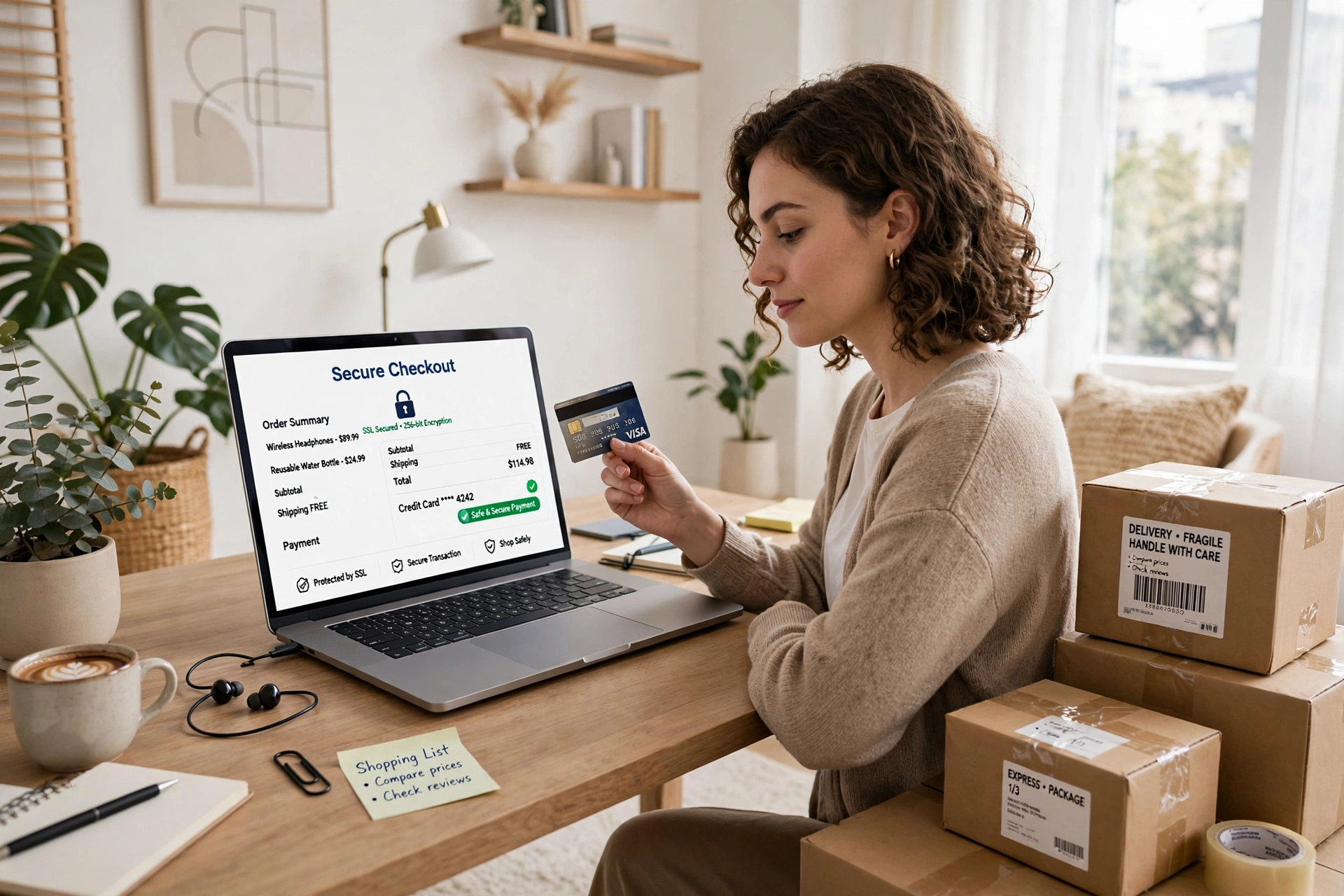
Before entering any payment details, confirm the checkout page uses HTTPS — look for the padlock icon in your browser’s address bar. No padlock on a page asking for card details? Close the tab. Then scroll to the footer. A real business lists a physical address, a phone number or live support channel, and a company name you can look up independently. A footer with no contact information at all — or nothing beyond a generic contact form — is one of the strongest signals of a fake store.
3. Search the store’s name before you buy
Take sixty seconds to search the store name alongside words like “scam”, “complaint”, or “reviews”. Scam stores burn fast: victims post warnings on Reddit, Trustpilot, and consumer forums within days of being burned. If you find nothing at all about a store that claims to have been running for years, be suspicious too — a genuine retailer leaves a visible footprint on the web.
Rules 4–6: Spot the Red Flags on the Page Itself
4. If the price is absurd, walk away
Flagship headphones for $19. A designer bag at ninety percent off. Scammers bait you with prices no legitimate business could survive, because they never intend to ship anything in the first place. Before buying from an unfamiliar store, check the same item at two or three well-known retailers. If one store’s price is dramatically lower than everywhere else, you are not getting a deal — you are getting bait.
5. Judge the store by how it presents its products
Legitimate retailers invest real effort in how they present what they sell: sharp original product photos, detailed specifications, honest sizing information, and copy that answers a buyer’s questions before they are asked. Fake stores do the opposite — blurry images lifted from elsewhere, one-sentence descriptions, awkward machine-translated text, and no specifications at all. This attention to how online stores present their products is one of the clearest trust signals on the internet, and it is exactly the craft behind professional ecommerce content writing services that help genuine retailers turn browsers into buyers.
6. Read the returns and refund policy first
Every honest store publishes a clear returns policy: how many days you have to return an item, who pays for return shipping, and how refunds are issued. Fake stores either hide the policy entirely or paste in contradictory legalese — “all sales final” sitting next to a “30-day money-back guarantee”. If you cannot find a returns policy within a minute of looking, treat the store as guilty until proven innocent.
Rules 7–8: Pay in Ways You Can Reverse
7. Use a credit card or a protected payment service
Your payment method is your safety net. Credit cards and services like PayPal let you dispute a charge and recover your money when a seller vanishes. Bank transfers, wire services, gift cards, and cryptocurrency payments do not — once that money leaves your hands, it is effectively gone. Any store that pushes you toward gift cards, peer-to-peer payment apps, or wire transfers “for an extra discount” is announcing its plan to disappear.
8. Never shop on public Wi-Fi
Open coffee-shop and airport networks are playgrounds for data thieves, who can intercept what you type on unsecured connections — including login credentials and card numbers. If you must shop away from home, use your phone’s mobile data or a reputable VPN. Never enter payment details while connected to a public hotspot.
Rules 9–10: Lock Down Your Accounts and Your Evidence
9. Give every store its own strong password
Account takeovers are how shoppers get burned twice: once by a scam store, and again when a reused password lets criminals into their email or bank account. Use a password manager to generate a unique password for every store, and switch on two-factor authentication wherever it is offered. A single breach should never become five.
10. Keep your receipts
Save every order confirmation email, screenshot the product page showing the price and promised delivery date, and keep your payment receipts. If a dispute ever reaches your card issuer, this paper trail is what wins it. Most shoppers lose disputes they should have won simply because they cannot prove what was originally promised.
Rules 11–12: If You Get Scammed, Fight Back Fast
11. Act within days, not months
The moment a delivery deadline passes and the seller goes quiet, start the clock. Contact the seller once, in writing, asking for a refund — then escalate quickly if you get silence or excuses. Card networks typically allow chargebacks for around 120 days from the transaction, but the sooner you act, the stronger your case and the better your chances of recovering the money.
12. Work the dispute ladder
- Dispute the charge with your card issuer or PayPal — this is your strongest weapon, and it is exactly why Rule 7 matters so much.
- Report the store to the consumer protection authorities in your country. In the United States, that means the FTC’s ReportFraud website and the FBI’s Internet Crime Complaint Center; most countries have an equivalent agency.
- Warn the next shopper by leaving honest reviews wherever future victims are likely to search. Your warning may be the one that saves someone else.
The Confident Shopper’s Checklist
Shopping online does not have to feel like a gamble. The pattern is always the same: verify the store, sanity-check the price, read the returns policy, pay with a reversible method, and keep your evidence. Retailers who do things properly — the ones building real businesses by earning trust order after order — have nothing to hide: clear contact details, honest presentation, fair policies, and secure checkout. That trust-first playbook is also how eCommerce businesses grow sustainably over time, and once you learn to recognize it, spotting the fakes becomes second nature. Bookmark these rules, share them with anyone who shops online, and buy with confidence.