
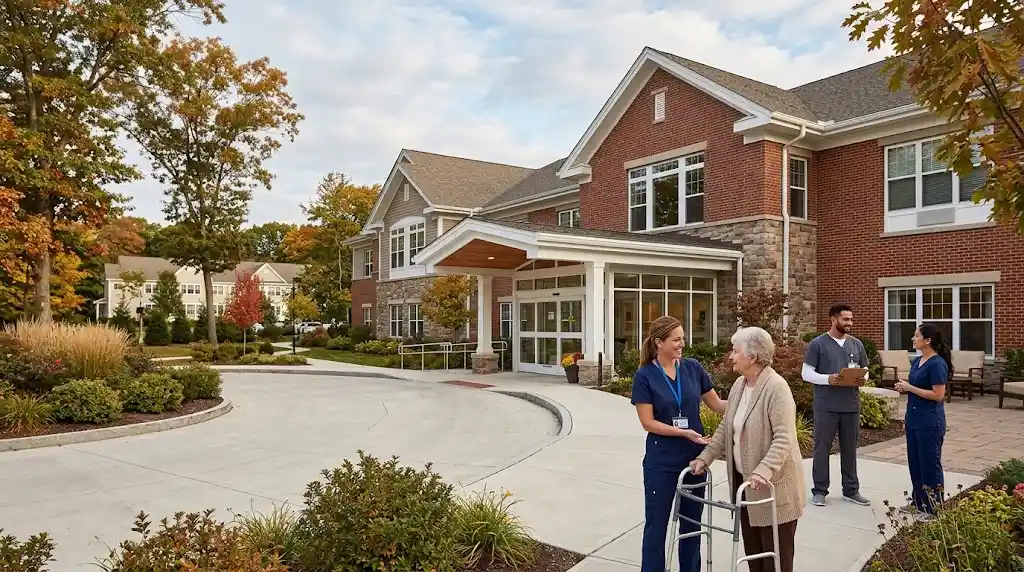
What Is Alliance Health at Rosewood?
Alliance Health at Rosewood is located at 22 Johnson Street in West Peabody, Massachusetts. The facility’s current materials identify it as a skilled nursing and rehabilitation center with 135 beds. Its services are designed for people who may need rehabilitation following illness or injury, skilled nursing support, post-acute care, or longer-term assistance.
Rosewood’s published information also describes the facility as a nonprofit, Medicare-certified skilled nursing facility and states that it is Joint Commission accredited. Its care model emphasizes working with residents and their families to develop individualized plans of care.
Services Available at Alliance Health at Rosewood
The range of services is one of the main reasons families may encounter Rosewood when researching post-hospital rehabilitation, skilled nursing, or long-term care. Available services can vary according to a resident’s clinical needs and the facility’s current capabilities.
24-Hour Skilled Nursing Care
Rosewood provides 24/7 skilled nursing care. Its current facility brochure describes nursing care as being personalized to the needs of each resident. The clinical team also includes a physician-directed multidisciplinary approach.
This type of setting can be relevant for people who need ongoing nursing oversight after hospitalization or for residents whose medical needs require more support than can reasonably be provided in an independent living environment.
Short-Term Rehabilitation
Rehabilitation is an important component of Rosewood’s services. The facility offers in-house physical, occupational, and speech and language therapy. Therapists evaluate residents and develop treatment approaches intended to help them regain skills and increase independence following illness or injury.
Depending on the patient’s needs, rehabilitation may focus on mobility, daily activities, communication, cognition, or swallowing.
Post-Acute Care
Rosewood has a post-acute unit for patients discharged from the hospital. Post-acute care can provide a structured transition between hospital treatment and returning home or moving to another appropriate level of care.
The facility’s published materials specifically identify post-acute care as one of its core service areas.
Long-Term Care
For residents who need ongoing support, Rosewood also provides long-term care. Its current brochure identifies custodial care, respite stays, and hospice care among the services associated with its long-term-care offering.
Physical, Occupational, and Speech Therapy
Rosewood’s therapy team includes physical, occupational, and speech and language therapists. The facility says these services are provided in-house and are designed around each patient’s needs.
- Physical therapy: Can address mobility, strength, physical function, and recovery after illness or injury.
- Occupational therapy: Can help residents regain skills needed for everyday activities.
- Speech and language therapy: Can address communication, cognition, and swallowing needs.
Specialized Clinical Services
Rosewood’s current brochure lists several clinical services beyond basic nursing and rehabilitation. These include orthopedic rehabilitation, stroke recovery, cardiac care, post-operative care, pain management, pulmonary and respiratory care, wound care management, diabetes management, memory support, and in-house hospice and palliative care.
Earlier facility materials also list services such as oxygen management, tracheostomy care, IV therapy, wound management, diabetic teaching, stroke rehabilitation, cardiac rehabilitation, post-operative care, and enteral feeding. Availability and treatment decisions depend on the individual patient’s needs and the facility’s current clinical protocols.
Rehabilitation After Illness or Injury
Recovery after an illness, injury, surgery, stroke, or hospitalization can involve several different goals. Some patients may need help improving mobility, while others may need assistance relearning daily activities or addressing communication and swallowing problems.
Rosewood’s therapy model brings several rehabilitation disciplines together. Its published materials explain that therapists provide comprehensive evaluation and treatment with the goal of helping patients reach a higher level of independence while accounting for changes following illness or injury.
For families comparing rehabilitation options, it can be useful to ask which therapies are available, how often therapy is provided, how progress is documented, and how the care team communicates with the patient’s family and existing healthcare providers.
Patient-Centered and Individualized Care
Rosewood’s materials emphasize individualized care planning and collaboration with residents and their families. Its earlier brochure describes a care approach in which clinicians and staff work directly with residents and families to develop individualized plans.
Individualized care is particularly important in skilled nursing because residents can have very different combinations of medical, functional, cognitive, and personal needs. A rehabilitation plan for someone recovering from orthopedic surgery may look very different from one developed for a person recovering from a stroke or managing a chronic condition.
Comfort, Activities, and Resident Amenities
Healthcare is only one part of the experience in a residential care setting. Rosewood’s published materials also describe recreational activities, social gatherings, social services, case management, dining, housekeeping and laundry, lounge areas, a library, hair salon services, and cable, Wi-Fi, and telephone availability.
The facility also lists private and semi-private rooms among its amenities.
These features can matter to residents and families because comfort, communication, social interaction, and daily routines can influence how manageable a longer stay feels.
Hospice and Palliative Care
Rosewood’s current clinical-services list includes in-house hospice and palliative care.
These services serve a different purpose from rehabilitation. Rehabilitation generally focuses on improving function or independence, while palliative and hospice services are concerned with comfort, symptom management, quality of life, and support during serious or end-of-life illness.
Families considering these services should discuss eligibility, goals of care, available support, and coordination with the resident’s physicians and other healthcare professionals.
What Families Should Consider Before Choosing a Skilled Nursing Facility
Finding the right facility involves more than looking at the list of services. Families should consider the specific medical and functional needs of the person who will receive care.
1. Clinical Needs
Ask whether the facility routinely manages the medical conditions, rehabilitation requirements, medications, mobility needs, respiratory needs, wound-care needs, or other services relevant to the prospective resident.
2. Rehabilitation Services
If rehabilitation is the primary reason for admission, ask about the available therapy disciplines, therapy schedule, treatment goals, progress reviews, and communication between therapists and the rest of the care team.
3. Nursing Support
Ask how nursing care is organized, how medical changes are handled, and how families are notified about significant changes in condition.
4. Care Planning
A clear care plan helps coordinate medical treatment, rehabilitation, daily activities, medications, nutrition, and other services. Families should understand how they can participate in care planning.
5. Living Environment
For longer stays, consider room arrangements, dining, recreation, social activities, housekeeping, communication services, and other aspects of everyday life.
Alliance Health at Rosewood and Healthcare Education
Understanding how healthcare organizations approach assessment and patient care can also be useful for nursing students. For example, digital clinical simulations such as the Shadow Health Comprehensive Assessment give students opportunities to practice patient interviews, physical assessment, documentation, and clinical reasoning in an educational environment.
That type of simulation is different from the real-world skilled nursing environment at Rosewood, but both emphasize the importance of organized assessment, communication, documentation, and individualized patient care.
How Rehabilitation Fits Into the Broader Care Journey
Rehabilitation is often only one part of a patient’s broader care journey. A person may move from hospital treatment to post-acute care, participate in rehabilitation, transition home, and continue receiving appropriate medical or support services.
Families researching different forms of support can also explore resources about home care services and compassionate home care when evaluating options outside a residential facility.
For people interested in other healthcare organizations and care models, ZenithNote also covers topics such as healthcare services in Franklin, Ohio, health and rehabilitation services, and home health services.
Frequently Asked Questions
Where is Alliance Health at Rosewood located?
Alliance Health at Rosewood is located at 22 Johnson Street in West Peabody, Massachusetts. The facility’s current brochure lists the same address and provides its main telephone number as 978-535-8700.
How many beds does Alliance Health at Rosewood have?
The facility’s current materials identify 135 total beds.
What services does Alliance Health at Rosewood provide?
Services include 24-hour nursing care, rehabilitation, post-acute care, long-term care, physical therapy, occupational therapy, speech and language therapy, orthopedic rehabilitation, stroke recovery, cardiac care, post-operative care, wound care, diabetes management, memory support, and hospice and palliative care.
Does Alliance Health at Rosewood provide rehabilitation?
Yes. The facility provides in-house physical, occupational, and speech and language therapy. Its materials describe rehabilitation services designed to help residents regain skills and independence following illness or injury.
Does Rosewood provide long-term care?
Yes. Long-term care is one of the services listed by Alliance Health at Rosewood, alongside custodial care, respite stays, and hospice care.
Does Rosewood provide hospice care?
Yes. The facility’s current materials list in-house hospice and palliative care among its clinical services.
Final Thoughts
Alliance Health at Rosewood is a 135-bed skilled nursing and rehabilitation facility in West Peabody, Massachusetts. Its published services span 24-hour nursing care, post-acute care, rehabilitation, long-term care, specialized clinical services, and hospice and palliative care.
For families researching care options, the most useful starting point is to match the facility’s services with the individual’s specific medical, rehabilitation, functional, and daily-living needs. A direct conversation with the facility and the person’s healthcare team can help determine whether its current services are appropriate for a particular situation.