Anyone considering Dash mining should therefore think beyond the advertised block reward. Mining is a competitive business in which revenue and operating costs can change continuously.
What Is Dash Mining?
Dash mining uses computational power to find valid solutions for the network’s proof-of-work requirements. When a miner successfully produces a valid block, that block can be added to the Dash blockchain and the miner receives a share of the applicable block subsidy and transaction fees.
Dash uses the X11 proof-of-work algorithm. X11 is a chained hashing system that uses eleven different cryptographic hashing functions. ASIC hardware specifically designed for X11 is widely used for Dash mining.
Mining is therefore both a security mechanism and an issuance mechanism. Miners contribute computational work to the network while newly created DASH and applicable transaction fees provide economic incentives for that work.
How Does Cryptocurrency Dash Mining Work?
At a high level, Dash mining follows the same basic proof-of-work concept used by other mineable cryptocurrencies.
- A miner connects specialized hardware to the Dash network directly or through a mining pool.
- The mining hardware repeatedly performs X11 calculations.
- The miner searches for a valid block solution that satisfies the network’s current difficulty target.
- A valid block is submitted to the network.
- Network participants verify the block.
- The miner and other eligible participants receive the applicable block reward allocation.
The difficulty of finding a block changes with network conditions. This means a mining machine that appears highly productive under one set of conditions may produce very different results later.
What Is the X11 Mining Algorithm?
X11 is the proof-of-work algorithm used by Dash. It combines eleven cryptographic hash functions in a sequence rather than relying on a single hashing function.
The algorithm was originally designed to provide a sophisticated chained-hashing approach for proof of work. However, specialized ASIC miners for X11 have existed for years, so modern Dash mining is not realistically comparable to early cryptocurrency mining performed with ordinary desktop computers.
For anyone researching mining equipment, this distinction is essential. Buying general-purpose hardware without checking X11 compatibility can result in an inefficient or completely unsuitable mining setup.
Can You Mine Dash With a GPU or CPU?
Dash’s mining ecosystem has evolved considerably since its early years. ASIC miners designed for X11 provide substantially greater mining efficiency than general-purpose CPUs or GPUs for this specific algorithm.
As a result, serious mainnet Dash mining is generally associated with dedicated ASIC hardware rather than ordinary desktop computers.
CPU or GPU experimentation may still be useful for educational purposes, development environments, or understanding how proof-of-work systems function, but it should not automatically be treated as a commercially viable mining strategy.
What Is a Dash ASIC Miner?
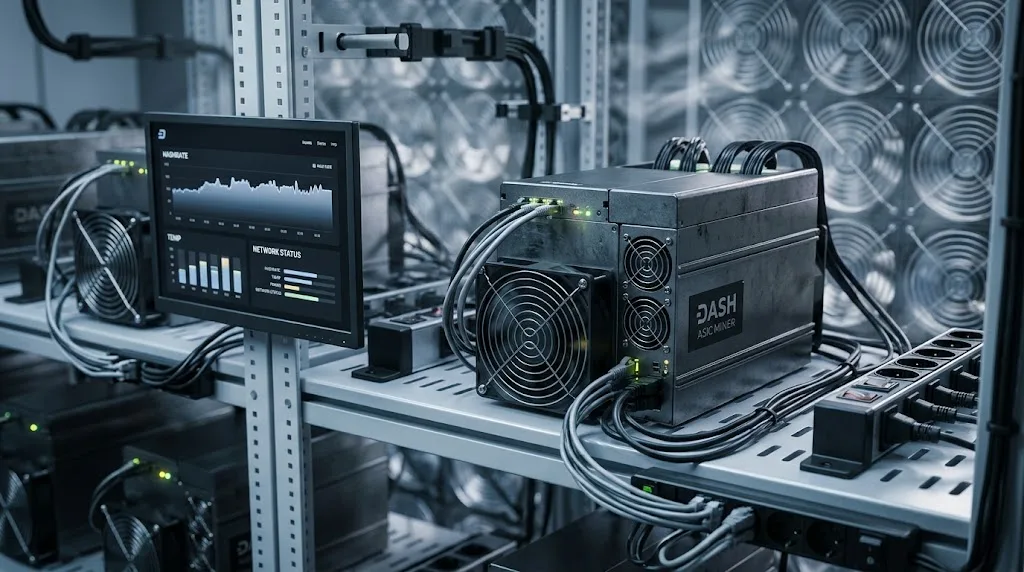
An ASIC, or application-specific integrated circuit, is hardware designed for a particular computational task. An X11 ASIC is specifically engineered to perform the calculations required by X11-based proof-of-work mining.
ASICs can offer a major efficiency advantage over general-purpose hardware because their architecture is optimized for the target algorithm.
However, ASIC mining introduces its own risks. Hardware can become outdated, resale values can fall, electricity prices can change, and mining difficulty can increase. A machine that looks attractive at purchase time may not remain profitable throughout its entire operating life.
How to Calculate Dash Mining Profitability
There is no permanent fixed profit figure for Dash mining. Profitability depends on several variables that can change independently.
A simplified calculation looks like this:
Mining Profit = Mining Revenue − Electricity Costs − Pool Fees − Hardware and Operating Costs
Mining revenue itself depends on factors such as your hardware hashrate, the current network difficulty, the applicable reward allocation, pool performance, and the market value of DASH.
Hashrate
Hashrate measures the computational work a mining machine can perform. A higher effective hashrate generally gives a miner a greater opportunity to contribute work toward finding blocks, although it does not guarantee a specific income.
Network Difficulty
Mining difficulty affects how difficult it is to discover valid blocks. As competitive mining conditions change, expected production can change as well.
Electricity Cost
Electricity is one of the largest ongoing expenses for ASIC mining. Two miners using identical hardware can have very different economics if their electricity rates differ significantly.
Hardware Efficiency
Power consumption relative to hashrate is critical. A machine producing a large hashrate can still be unattractive if it consumes too much electricity to achieve that output.
DASH Market Value
Mining produces DASH rather than a fixed dollar amount. The value of those rewards can fluctuate, which means revenue measured in U.S. dollars can change even when the miner’s technical performance remains constant.
Dash Mining Pools
Mining alone can produce highly unpredictable results because an individual machine represents only a small portion of the overall network hashrate. Mining pools allow multiple miners to combine their computational power and share rewards according to the pool’s payment system.
Dash’s official documentation notes that pool mining is more likely to generate rewards than solo mining and recommends considering P2Pool as a decentralized pool option. The documentation also lists several third-party pools for informational purposes.
Before joining a pool, compare:
- Pool fees
- Payment method
- Payout threshold
- Server location and latency
- Historical uptime
- Pool hashrate
- Withdrawal process
- Pool reputation
Do not assume that a pool listed in mining documentation is endorsed or guaranteed by Dash developers. Third-party mining services should be evaluated independently.
Dash Mining Reward Structure
Dash has a two-tier network consisting of miners and masternodes. This means the block subsidy is not structured in exactly the same way as Bitcoin’s mining reward.
According to current Dash documentation, 80% of the block subsidy is split between miners and masternodes, while the remaining 20% is reserved for the network’s decentralized budget system and can be allocated through governance proposals.
This structure is important when estimating mining revenue because a miner should not simply assume that 100% of the block subsidy belongs to the mining hardware that discovers the block.
Dash Mining vs. Dash Masternodes
Mining and running a masternode are separate activities within the Dash ecosystem.
Mining uses proof-of-work hardware to help secure the blockchain and produce blocks.
Masternodes form the network’s second tier and provide services associated with features such as InstantSend, CoinJoin, governance, and other Dash functionality.
Dash documentation states that operating a mainnet masternode requires 1,000 DASH as collateral, while mining does not require the same collateral arrangement.
These two activities should therefore not be treated as interchangeable investment strategies.
What You Need to Start Dash Mining
A basic Dash mining operation requires several components.
1. X11 ASIC Miner
The mining machine needs to support the X11 algorithm. Review its hashrate and power consumption rather than focusing solely on the manufacturer’s advertised performance.
2. Reliable Electricity
Mining equipment can operate continuously and consume substantial amounts of electricity. Your electricity rate should be one of the first variables entered into a profitability calculation.
3. Stable Internet Connection
A stable connection helps mining hardware communicate with the selected pool and receive new work efficiently.
4. Cooling and Ventilation
ASIC miners generate significant heat and noise. Proper ventilation and temperature management are essential for maintaining hardware performance and reducing the risk of thermal problems.
5. Dash Wallet
You need a secure Dash-compatible address for receiving mining payouts. Wallet security becomes increasingly important as the value of accumulated rewards grows.
6. Mining Pool Account
If you choose pooled mining, you will need to configure your ASIC with the pool’s connection details and payout information.
How to Set Up a Dash Mining Operation
The exact setup procedure depends on the ASIC manufacturer and mining pool, but the general process is straightforward.
- Choose an X11-compatible ASIC miner.
- Calculate expected electricity costs.
- Compare available mining pools.
- Create or secure a Dash wallet.
- Connect the ASIC to a suitable power supply and network.
- Enter the mining pool’s server and worker information.
- Configure the payout address where applicable.
- Monitor hashrate, temperature, power consumption, rejected shares, and pool performance.
- Recalculate profitability regularly as network conditions change.
Mining software and configuration details can change depending on the ASIC manufacturer, so the hardware manufacturer’s documentation should be followed for device-specific settings.
How Much Electricity Does Dash Mining Use?
Electricity consumption depends entirely on the ASIC model and its operating configuration. Two machines can have very different power requirements even if both are marketed as X11 miners.
To estimate electricity costs, multiply the miner’s power consumption in kilowatts by the number of operating hours and your electricity price.
For example:
Daily electricity cost = Power consumption in kW × 24 hours × electricity price per kWh
This calculation should be performed before purchasing hardware. Electricity can determine whether mining produces a positive operating margin or a loss.
Is Dash Mining Profitable?
Dash mining can be profitable under favorable conditions, but profitability is not guaranteed.
The official Dash documentation specifically warns that mining profitability depends on the hashrate of the mining device, network difficulty, hardware costs, and electricity costs. Those variables can change quickly.
A realistic profitability analysis should therefore include both best-case and worst-case scenarios rather than relying on a single calculator result.
Factors That Can Improve Mining Economics
- Low-cost electricity
- Efficient X11 ASIC hardware
- Competitive hardware pricing
- Reliable mining-pool performance
- Effective cooling
- Favorable DASH market conditions
Factors That Can Reduce Profitability
- High electricity prices
- Increasing network difficulty
- Hardware failure
- ASIC depreciation
- Pool fees
- Falling DASH prices
- Cooling and infrastructure expenses
Common Dash Mining Mistakes
Buying Hardware Without Checking Electricity Costs
The purchase price of an ASIC is only the beginning. Electricity can become the dominant operating expense over time.
Using Outdated Profitability Estimates
Mining calculators can become outdated quickly because difficulty, network hashrate, electricity rates, and cryptocurrency prices change.
Ignoring Heat and Noise
ASIC mining equipment is not designed to operate like a quiet home computer. Cooling and ventilation should be planned before installation.
Assuming Mining Guarantees Income
Mining rewards are probabilistic and competitive. Even technically reliable hardware does not guarantee a fixed daily income.
Neglecting Wallet Security
Mining rewards are only useful if they can be stored securely. Protect wallet credentials and never share private keys or recovery phrases.
Dash Mining and the Broader Cryptocurrency Market
Dash mining should be considered as one component of the wider cryptocurrency ecosystem rather than as an isolated source of potential income.
For readers exploring other digital-asset strategies, our guide to cryptocurrency leverage trading covers a very different risk model. Mining involves hardware, electricity, infrastructure, and network competition, while leverage trading introduces additional market and liquidation risks.
Likewise, people holding significant digital assets may want to consider risk-management topics such as cryptocurrency insurance.
For the legal side of operating a cryptocurrency business or undertaking significant digital-asset activity, our guide to cryptocurrency lawyers provides additional context.
Frequently Asked Questions
What algorithm does Dash use for mining?
Dash uses the X11 proof-of-work algorithm. Modern Dash mining is primarily associated with specialized X11 ASIC hardware.
Can you still mine Dash?
Yes. Dash remains a proof-of-work cryptocurrency and its official documentation continues to provide mining information, including guidance on ASIC hardware and mining pools.
Is Dash mining profitable?
It depends. Electricity costs, ASIC efficiency, network difficulty, mining-pool fees, hardware costs, and the market value of DASH all affect profitability. No fixed profit figure applies to every miner.
Do you need an ASIC to mine Dash?
ASIC hardware is the practical choice for competitive Dash mainnet mining because X11-specific ASIC miners provide far greater efficiency than general-purpose CPU or GPU hardware.
Is Dash mining the same as running a masternode?
No. Mining uses proof-of-work hardware to produce blocks, while masternodes operate a separate second tier of the Dash network. Dash documentation states that a mainnet masternode requires 1,000 DASH as collateral.
What is the biggest cost of Dash mining?
For many mining operations, electricity is a major ongoing cost. Hardware purchase, cooling, infrastructure, maintenance, and pool fees can also materially affect the final economics.
Final Thoughts
Cryptocurrency Dash mining remains a specialized proof-of-work activity built around the X11 algorithm. Modern miners generally need purpose-built ASIC hardware, reliable infrastructure, competitive electricity rates, and careful monitoring to operate effectively.
The most important point is that mining should be treated as a variable-cost operation rather than a guaranteed income opportunity. Network difficulty, hardware performance, electricity prices, pool fees, and the value of DASH can all change the result.
Before purchasing an ASIC, calculate the expected operating costs under several scenarios and allow room for changing market conditions. Regularly update the calculation after deployment rather than assuming the original estimate will remain accurate.
Dash mining can provide a way to participate directly in securing a proof-of-work blockchain, but profitability depends on the economics of the individual operation. Careful research and realistic cost modeling are more valuable than headline profit estimates.
Cryptocurrency mining involves financial and operational risk. Mining rewards are not guaranteed, and this article does not constitute investment or financial advice.