
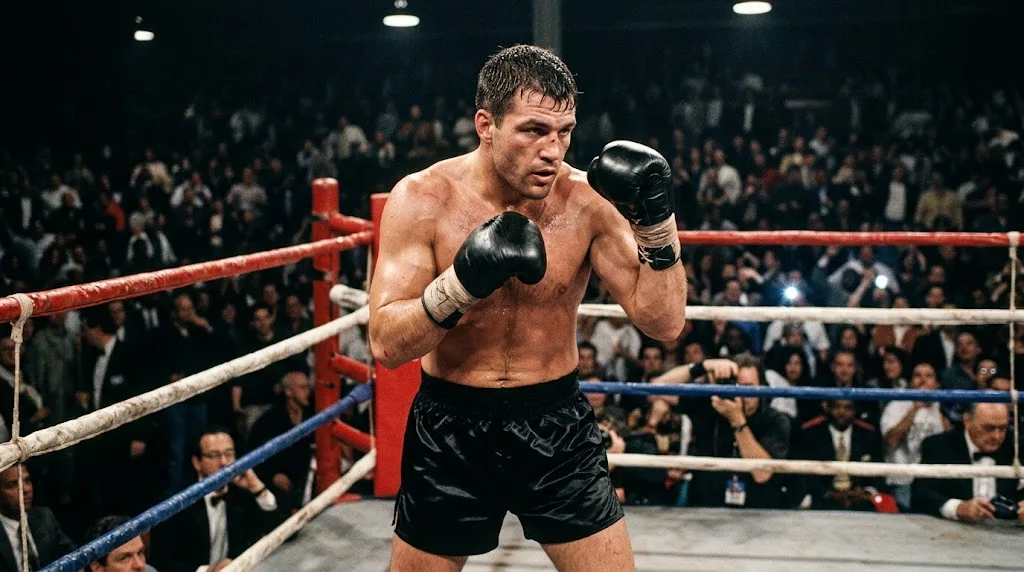
This guide examines Peter McNeeley’s verified boxing statistics, his early professional career, knockout record, famous fight with Mike Tyson, major opponents, and the legacy he left in heavyweight boxing.
Peter McNeeley Stats at a Glance
| Statistic | Peter McNeeley |
|---|---|
| Nickname | Hurricane |
| Division | Heavyweight |
| Professional record | 47–7 |
| Total professional bouts | 54 |
| Wins by knockout | 36 |
| Wins by decision | 9 |
| Wins by disqualification | 2 |
| Losses by knockout | 6 |
| Losses by disqualification | 1 |
| Height | 6 ft 2 in (188 cm) |
| Reach | 77 in (196 cm) |
| Stance | Orthodox |
McNeeley’s official-style record data lists 54 professional fights, 47 wins, seven losses, and 36 wins by knockout. His listed height was 188 cm with a 196 cm reach, and he fought from an orthodox stance.
Who Was Peter McNeeley?
Peter Smith McNeeley was an American heavyweight boxer from Medfield, Massachusetts. He competed professionally during the 1990s and into the early 2000s, developing a reputation for an aggressive style and heavy punching.
Boxing was also part of McNeeley’s family background. His father, Tom McNeeley Jr., was a professional heavyweight who challenged Floyd Patterson for the world heavyweight championship in 1961.
McNeeley’s own career ultimately produced 47 professional victories, including 36 stoppages. While he did not become a long-reigning world heavyweight champion, his career became closely connected to one of the most commercially significant heavyweight events of the 1990s.
Peter McNeeley’s Professional Boxing Record
McNeeley ended his career with a 47–7 professional record. His 36 knockout victories represented the majority of his wins, highlighting the power-oriented style that defined much of his career.
His record can be broken down as follows:
- 54 total fights
- 47 wins
- 36 wins by knockout
- 9 wins by decision
- 2 wins by disqualification
- 7 losses
- 6 losses by knockout
- 1 loss by disqualification
Using the 36 knockout wins against 47 total victories, approximately 76.6% of McNeeley’s wins came by knockout. That is a considerably different picture from the outdated 51% knockout figure previously published on this page.
How Powerful Was Peter McNeeley?
The numbers suggest that knockout power was one of McNeeley’s defining characteristics. Thirty-six of his 47 victories ended inside the distance, meaning his opponents frequently struggled to survive the full scheduled distance.
One of the clearest examples came in April 1995, when McNeeley stopped Frankie Hines just six seconds into the first round. BoxRec records the bout as a first-round TKO at 0:06 after McNeeley landed a left hook.
That performance became one of the notable statistical curiosities of his career and reinforced his reputation as an explosive heavyweight puncher.
Peter McNeeley’s Early Career
McNeeley turned professional in 1991 and quickly accumulated victories. His early record was built largely through aggressive performances and frequent stoppages, helping him establish himself as a recognizable heavyweight contender.
By the time he entered the spotlight in 1995, McNeeley had compiled a strong record and had developed a reputation for coming forward rather than fighting cautiously.
That style made him an appealing opponent for Mike Tyson’s highly anticipated comeback, even though the difference in experience at the elite level would become apparent almost immediately once the two men entered the ring.
Peter McNeeley vs. Mike Tyson
The most famous fight of McNeeley’s career took place on August 19, 1995, at the MGM Grand in Las Vegas.
The bout was significant because it marked Mike Tyson’s return to professional boxing after more than four years away from the ring. Tyson had been released from prison earlier in 1995, and enormous public attention surrounded his comeback.
McNeeley entered the fight with a 36–1 record, according to contemporary reporting, while Tyson entered with a 41–1 record. McNeeley was presented as an aggressive opponent capable of providing immediate action.
What Happened in the Tyson Fight?
The fight lasted only 89 seconds.
McNeeley rushed forward immediately after the opening bell. Tyson avoided the initial attack and dropped McNeeley early. McNeeley recovered and continued attacking, but Tyson knocked him down again.
McNeeley’s manager, Vinnie Vecchione, then entered the ring. Referee Mills Lane disqualified McNeeley, giving Tyson the victory. BoxRec records the official result as Tyson winning by first-round disqualification at 1:29.
Although the result was officially a disqualification rather than a knockout, the bout became one of the most recognizable moments in McNeeley’s career.
Why the Tyson Fight Became So Famous
The event was much bigger than a normal heavyweight contest. Tyson’s return generated enormous public interest after his lengthy absence, and the fight was promoted as a major entertainment event.
Contemporary reporting described Tyson as a heavy favorite before the contest, while McNeeley’s aggressive personality and pre-fight confidence added to the spectacle.
Three decades later, the fight remains notable not because of its competitive length but because it demonstrated the commercial power of Tyson’s comeback. A 2025 retrospective from The Guardian noted that the event generated approximately $96 million in television revenue and 1.52 million U.S. household pay-per-view orders.
Was Peter McNeeley a Serious Contender?
The answer depends on how “contender” is defined.
McNeeley had a strong professional record and considerable knockout power. His 47–7 career record and 36 stoppage victories demonstrate that he was a successful professional heavyweight rather than an ordinary club fighter.
However, his position in the heavyweight hierarchy should not be confused with that of champions such as Tyson, Evander Holyfield, or Lennox Lewis. McNeeley never won a recognized world heavyweight championship.
His career is better understood as that of a durable, aggressive heavyweight who reached a major stage and became internationally famous through his association with Tyson’s comeback.
Peter McNeeley’s Boxing Style
McNeeley’s approach was built around pressure and aggression. Rather than relying primarily on extended technical exchanges from long range, he often attempted to bring the fight to his opponent and create opportunities with heavy punches.
That approach could be effective against opponents who struggled under pressure. It also created vulnerabilities against experienced heavyweights who could exploit openings created by an aggressive attack.
The Tyson fight demonstrated both sides of that equation. McNeeley’s willingness to attack immediately created excitement, but Tyson’s speed, timing, and power allowed him to capitalize on the openings.
Peter McNeeley’s Later Career
McNeeley continued boxing after the Tyson bout and remained active for several years.
His later career included fights against experienced heavyweights, and he ultimately finished with seven professional losses. BoxRec’s record shows that his final professional bout came in June 2001, when Mike Bernardo stopped him in the first round in Cape Town.
His career therefore extended well beyond the 1995 Tyson fight, even though that single event remained the defining public memory associated with his name.
Peter McNeeley vs. Other Heavyweights of His Era
McNeeley competed during a heavyweight era dominated by several historically important fighters. Mike Tyson, Evander Holyfield, Lennox Lewis, Riddick Bowe, and other elite heavyweights shaped the division during the period.
McNeeley’s career statistics compare favorably in terms of raw knockout production, but statistics alone do not establish a fighter’s standing. The quality of opposition, championship success, rankings, and performances against elite opponents are equally important.
That distinction explains why McNeeley can simultaneously have an impressive 47–7 record and remain outside the historical group of heavyweight champions who defined the era.
What Makes Peter McNeeley’s Career Memorable?
McNeeley’s legacy is unusual because one fight became disproportionately important to his public identity.
His complete career included 54 professional bouts and 47 victories, but casual boxing fans often know him primarily as Mike Tyson’s comeback opponent.
That does not erase his accomplishments. A professional record featuring 36 knockout victories represents a substantial career in its own right. His willingness to fight aggressively and his ability to produce early stoppages made him an entertaining figure during his time in the heavyweight division.
The Tyson bout simply gave that career a permanent place in boxing history.
Peter McNeeley Stats: What the Numbers Really Tell Us
The most useful way to understand McNeeley’s statistics is to look beyond the headline record.
- 47–7 record: McNeeley won nearly seven out of every eight professional bouts.
- 36 knockout wins: His victory total was heavily driven by stoppages.
- 54 professional fights: His career was substantially longer than the simplified statistics sometimes repeated online.
- Six knockout losses: His aggressive style also exposed him to stoppage defeats.
- 1995 Tyson bout: His most famous fight ended in a first-round disqualification after his corner entered the ring.
Together, these numbers describe an aggressive heavyweight with legitimate professional success, substantial knockout power, and a career that reached an extraordinary level of public attention through one historic event.
Frequently Asked Questions About Peter McNeeley
What was Peter McNeeley’s boxing record?
Peter McNeeley finished his professional boxing career with a 47–7 record across 54 bouts, including 36 victories by knockout.
How many knockouts did Peter McNeeley have?
McNeeley recorded 36 knockout victories during his professional career.
Did Peter McNeeley beat Mike Tyson?
No. Mike Tyson defeated McNeeley by first-round disqualification on August 19, 1995. The fight ended at 1:29 of the opening round after McNeeley’s manager entered the ring.
How long did Tyson vs. McNeeley last?
The bout lasted 89 seconds, ending at 1:29 of the first round.
Was Peter McNeeley a heavyweight?
Yes. McNeeley competed as a professional heavyweight and was listed at 6 ft 2 in (188 cm) with a 77-inch (196 cm) reach.
What was Peter McNeeley known for?
McNeeley is best known for his aggressive heavyweight style, his 47–7 professional record with 36 knockouts, and especially his 1995 fight against Mike Tyson, which marked Tyson’s return to professional boxing.
Final Thoughts
Peter McNeeley’s career deserves more than a footnote attached to the Mike Tyson comeback. His verified professional record of 47 wins, seven losses, and 36 knockout victories shows that he was a successful and dangerous heavyweight who built his reputation through aggression and punching power.
His fight with Tyson remains the defining chapter because of its enormous audience, dramatic buildup, and extraordinarily short duration. Yet McNeeley’s broader career provides a more complete picture of a fighter who spent years competing professionally and consistently looked for opportunities to make an impact.
For boxing historians and fans, the most accurate assessment is therefore a balanced one: McNeeley was not a world heavyweight champion, but he was a legitimate professional heavyweight with a strong record, considerable knockout power, and a permanent place in the history of one of boxing’s most famous comeback events.