
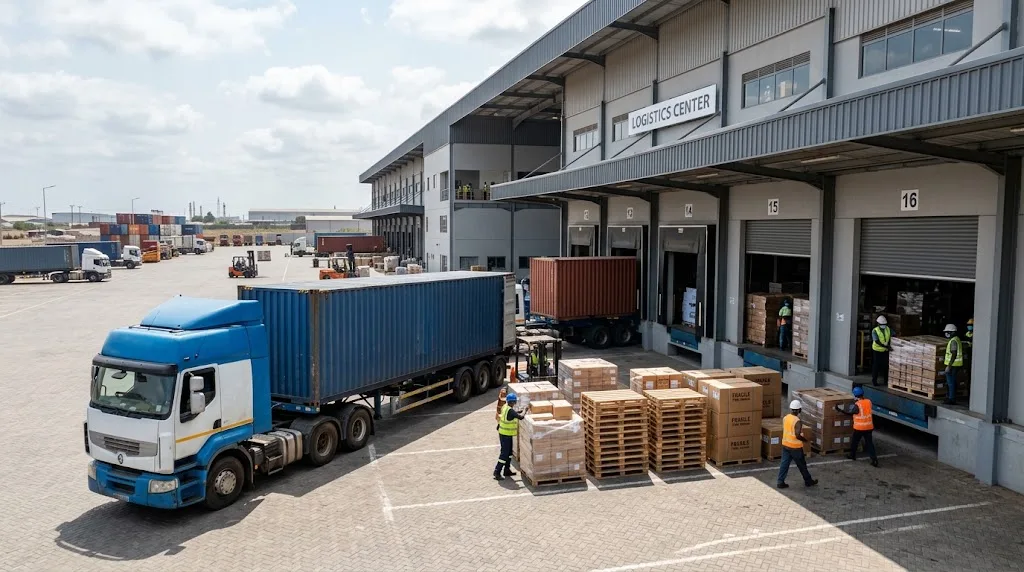
What Is Kilopost Logistics Africa?
Kilopost describes itself as a logistics infrastructure provider focused on helping enterprises move goods through technology-enabled delivery and supply chain services. Its published service information emphasizes high-volume logistics, pickup coordination, warehouse support, long-distance freight movement, and enterprise-level delivery operations.
The company identifies Ghana as a core market, with a stated ambition to support commerce across Africa. Businesses researching Kilopost Logistics Africa should distinguish this broader mission from confirmed service availability on an individual route or in a particular country.
Before entering a service agreement, confirm the relevant operating locations, pickup coverage, delivery destinations, shipment restrictions, pricing structure, and customer support arrangements directly with the provider.
For a wider perspective on supply chain operations, readers can also explore warehouse and freight logistics services and how coordinated logistics activities support business distribution.
Why Logistics Matters for African Businesses
Logistics connects production with demand. Manufacturers need raw materials and components to arrive when required, distributors need dependable replenishment, and retailers need products available when customers place orders. Inefficient transportation or poorly coordinated warehouse activities can disrupt these processes and increase operating costs.
Businesses operating across African markets may also need to account for different road conditions, transport infrastructure, documentation requirements, delivery distances, and border procedures. A suitable logistics partner can help coordinate these moving parts, provided its network and service capabilities match the shipment requirements.
Well-planned logistics can support several business objectives:
- More predictable deliveries: Defined pickup schedules and delivery procedures help teams plan inventory and customer commitments.
- Improved inventory movement: Better coordination between storage locations and transport operations reduces avoidable delays.
- Greater shipment visibility: Tracking information helps businesses understand shipment progress and investigate exceptions.
- Cost control: Appropriate route planning, shipment consolidation, and handling procedures can reduce unnecessary expenses.
- Business scalability: Logistics capacity that matches changing demand can help companies manage growth more effectively.
Key Logistics Services Described by Kilopost
Kilopost’s official website describes a portfolio centered on high-volume delivery, end-to-end logistics coordination, and enterprise shipping. The exact scope available to an individual customer should be confirmed when requesting a quotation.
High-Volume Delivery
Businesses that regularly move large quantities of goods need logistics arrangements that can accommodate recurring demand. Kilopost describes high-volume delivery solutions for enterprises, including the technology-driven movement of goods across major cities.
Before choosing a high-volume delivery arrangement, businesses should establish expected shipment quantities, delivery frequency, handling requirements, operating hours, and procedures for peak periods.
Warehouse Support and Inventory Movement
Warehousing helps businesses manage the gap between receiving products and delivering them to their next destination. Kilopost identifies warehousing support as part of its broader logistics chain.
Depending on the agreed service scope, warehouse-related requirements may involve receiving coordination, storage arrangements, inventory handling, staging, or preparation for onward delivery. Businesses should ask which of these functions are actually included rather than assume every warehouse service is available.
Effective warehouse coordination is particularly valuable when inbound shipments, storage capacity, and outbound delivery schedules must remain aligned.
Long-Distance Freight Movement
Moving goods over longer distances requires coordination between pickup, transport planning, intermediate handling where applicable, and final delivery. Kilopost describes long-distance freight movement within its end-to-end logistics offering.
For a specific shipment, request confirmation of the origin and destination coverage, available transport method, expected transit time, cargo limits, tracking arrangements, and responsibility for delays or damaged goods.
Enterprise Delivery Operations
Large businesses often need more than individual shipment bookings. They may require recurring delivery schedules, standardized procedures, operational reporting, and a consistent point of contact.
Kilopost positions its services toward enterprises, factories, distributors, and e-commerce businesses that need to move products at scale. Companies should discuss their actual shipment profile and confirm whether the proposed service can meet their operational requirements.
Store-to-Door Delivery
Kilopost also describes a store-to-door solution intended to connect inventory locations with customers. This type of logistics arrangement can help businesses coordinate the movement of products from storage or pickup points to their intended recipients.
Businesses considering this service should confirm delivery-area coverage, collection procedures, delivery estimates, proof-of-delivery options, failed-delivery handling, and any additional charges.
How Technology Can Improve Shipping and Supply Chains
Digital tools can make logistics easier to coordinate by helping businesses obtain quotations, arrange pickups, monitor shipments, and manage delivery information. Kilopost’s official website describes several technology-oriented features intended to support its logistics services.
Smart Quoting
Kilopost describes a smart quoting feature that calculates shipping estimates. Clear pricing information can help businesses compare available options and plan transportation expenses.
Before relying on an estimate, confirm what the price includes, whether it is binding, which surcharges may apply, and whether cargo dimensions, weight, distance, or special handling can change the final cost.
Pickup Coordination
A pickup-request feature can simplify the process of arranging collection. For businesses that dispatch goods frequently, a consistent pickup process can reduce manual coordination and help teams prepare shipments more efficiently.
Confirm pickup availability, booking cut-off times, required packaging, collection windows, and the process for changing or cancelling a request.
Shipment Tracking and Visibility
Kilopost describes its Live Radar feature as a way to monitor parcel movement through real-time telemetry. Shipment visibility can help customers understand progress and respond when a delivery appears delayed.
Businesses should ask how frequently tracking information updates, what events are recorded, how exceptions are communicated, and whether tracking is available for every service type.
Digital Payment Options
Kilopost lists integrated mobile money payment functionality among its solutions. Digital payment options can make transactions more convenient, especially in markets where mobile money is widely used.
Customers should verify the payment methods available to them, transaction fees, refund procedures, and the security measures used to protect account and payment information.
Digital Identity and Shipment Records
Kilopost describes a Kilo Identity feature intended to simplify logistics transactions through a personalized identity. Businesses should establish how such an identifier is used, what information it contains, and how access to shipment records is managed.
Industries That May Benefit From Logistics Solutions
Manufacturing and Production
Manufacturers rely on the movement of components, raw materials, and finished products. A well-coordinated logistics arrangement can support production planning by helping teams organize inbound deliveries and outbound shipments.
Manufacturing businesses should confirm cargo handling requirements, delivery schedules, volume limits, and the procedures used when a shipment misses its planned arrival.
Wholesale and Distribution
Wholesalers and distributors often handle recurring orders for multiple customers. They need dependable inventory movement, accurate shipment records, and clear delivery communication.
Logistics providers can support these operations when their delivery coverage, handling capacity, and service schedules match the distributor’s requirements.
E-Commerce Businesses
Online retailers depend on a smooth transition from order preparation to delivery. Collection arrangements, shipment visibility, customer communication, and the handling of unsuccessful deliveries all influence the customer experience.
Before selecting a provider, e-commerce operators should check destination coverage, delivery estimates, parcel restrictions, return procedures, and available tracking integrations.
Retail and Consumer Goods
Retailers need stock to reach stores and customers at appropriate times. Coordinated transport and warehouse operations can help businesses maintain product availability while managing seasonal demand.
Companies with recurring distribution needs should evaluate service consistency, volume flexibility, handling requirements, and the total cost of delivery.
Cross-Border Shipping and Regional Supply Chains
Cross-border shipping can involve additional documentation, customs procedures, duties, transit arrangements, and country-specific requirements. A logistics provider’s stated ambition to serve a wider region does not by itself confirm that every route or customs service is available.
Businesses moving goods between African countries should identify the importer and exporter responsibilities, determine which documents are required, and confirm who will arrange customs clearance and pay applicable charges.
Depending on the route and cargo, companies may need to evaluate road, air, sea, or multimodal transport. The right option depends on delivery urgency, shipment size, cargo characteristics, route availability, and total landed cost.
For a broader overview of regional freight forwarding and customs coordination, consult DSV’s Africa logistics services. Its published information describes cross-border freight, customs brokerage, multimodal transport, and supply chain coordination across parts of Sub-Saharan Africa.
Before booking any cross-border shipment with Kilopost, confirm the specific countries served, route availability, documentation support, customs responsibilities, transit estimates, and any restrictions applying to the goods.
How to Evaluate Logistics Reliability
Fast shipping is valuable, but reliability also depends on communication, safe handling, consistent procedures, and effective exception management. Businesses should evaluate a logistics provider against measurable requirements instead of relying on general promotional claims.
- Service coverage: Verify the pickup and delivery locations supported for your specific route.
- Transit estimates: Obtain realistic timeframes and ask how delays are communicated.
- Shipment visibility: Confirm the availability and frequency of tracking updates.
- Customer support: Establish how to contact the provider about urgent shipments or service exceptions.
- Cargo handling: Discuss packaging, fragile goods, security, and any specialized requirements.
- Claims procedures: Review the process and deadlines for reporting lost or damaged shipments.
- Pricing transparency: Request written details of the full cost and potential additional fees.
Companies can also use a short pilot period, where commercially appropriate, to evaluate service quality before committing a large share of their logistics operations.
Managing Shipping Costs and Operational Efficiency
Shipping expenses include more than the base transportation rate. Packaging, collection, warehousing, handling, storage, unsuccessful deliveries, customs charges, and special service requirements can all affect the total cost.
Businesses should compare providers using equivalent shipment details and clearly defined service requirements. A low initial quote may not represent the best overall value if important services are excluded or delivery arrangements do not fit the business’s needs.
Practical ways to evaluate logistics costs include:
- Consolidating compatible shipments when timing and cargo requirements permit.
- Providing accurate shipment dimensions and weights when requesting quotes.
- Improving packaging to reduce avoidable damage and wasted space.
- Coordinating warehouse readiness with pickup schedules.
- Reviewing recurring delivery patterns to identify avoidable costs.
- Monitoring failed deliveries, delays, and handling exceptions.
- Comparing total service costs rather than transportation prices alone.
For businesses coordinating multiple logistics functions, the wider discussion of supply chain and logistics solutions can provide additional context for understanding how transportation, handling, and distribution work together.
Questions to Ask Before Choosing Kilopost
A detailed service inquiry helps establish whether Kilopost is suitable for a particular business requirement. Consider asking:
- Which pickup and delivery locations are currently supported?
- Can the service accommodate the expected shipment volume and frequency?
- What cargo types, dimensions, and weights are accepted?
- Which warehouse and freight services are included in the proposed arrangement?
- How are shipping estimates calculated, and what additional charges may apply?
- What shipment tracking and delivery confirmation options are available?
- How are delayed, missing, or damaged shipments handled?
- Which payment methods and transaction terms are supported?
- Are cross-border shipping and customs support available for the intended route?
- What service commitments, liability provisions, and cancellation terms apply?
Written answers make it easier to compare providers, establish expectations, and identify any gaps before starting regular shipments.
How to Get Started With Kilopost Logistics
Businesses interested in Kilopost can begin by reviewing its official website and contacting the company about their requirements. Its published website provides contact information for partnerships, enterprise services, and inquiries.
Prepare the following information before making an inquiry:
- Shipment origin and destination: Identify the pickup point and intended delivery location.
- Cargo details: Provide the shipment type, quantity, dimensions, weight, and any special handling requirements.
- Delivery schedule: Explain the required pickup date, delivery window, and shipment frequency.
- Expected volume: Estimate normal shipment activity and any seasonal changes.
- Service requirements: Specify whether you need collection, warehouse support, long-distance freight, or delivery to the final recipient.
- Technology needs: Ask about tracking, quoting, payment methods, and any required integrations.
- Commercial terms: Request pricing, service conditions, and the procedures for handling exceptions.
Visit the official Kilopost website to review its published services and contact the company for confirmation of current availability and terms.
Frequently Asked Questions
What is Kilopost Logistics?
Kilopost describes itself as a logistics provider focused on high-volume delivery, warehouse support, freight movement, and technology-enabled logistics services for businesses.
Where does Kilopost operate?
Kilopost’s website identifies Ghana as a core market and describes a broader ambition to connect commerce across Africa. Confirm the availability of a particular service, city, or cross-border route directly with the company.
Does Kilopost provide warehouse support?
Warehouse support is included in Kilopost’s published description of its end-to-end logistics chain. The exact storage, handling, and inventory services available should be confirmed for the customer’s location and requirements.
Can businesses track shipments through Kilopost?
Kilopost describes a Live Radar feature intended to provide shipment visibility. Customers should verify the tracking coverage, update frequency, and availability for their chosen service.
Does Kilopost offer cross-border shipping throughout Africa?
The company describes an ambition to build logistics infrastructure across Africa, but this does not confirm service availability on every route. Ask Kilopost to verify the countries, destinations, and cross-border arrangements relevant to your shipment.
How can a business request a shipping quote?
Businesses can use the company’s published contact channels to discuss their needs. Provide the origin, destination, cargo details, shipment frequency, and required delivery schedule to obtain a relevant estimate.
What should businesses compare when selecting a logistics provider?
Compare coverage, pricing, transit estimates, tracking, cargo handling, communication, claims procedures, and contractual terms. The most suitable provider is the one that can meet the business’s specific operational requirements on clearly defined terms.
Conclusion
Kilopost Logistics Africa presents a technology-oriented approach to shipping, high-volume delivery, warehouse support, and enterprise supply chain operations. Its published features include smart quoting, pickup coordination, shipment visibility, and digital payment functionality.
For businesses considering its services, the next step is to match those capabilities to a clearly defined shipment requirement. Confirm the operating locations, available routes, service scope, pricing, tracking arrangements, and applicable terms before making a commitment.
With careful evaluation and clear operating expectations, businesses can make better-informed decisions about logistics partners and build more predictable shipping and distribution processes.