
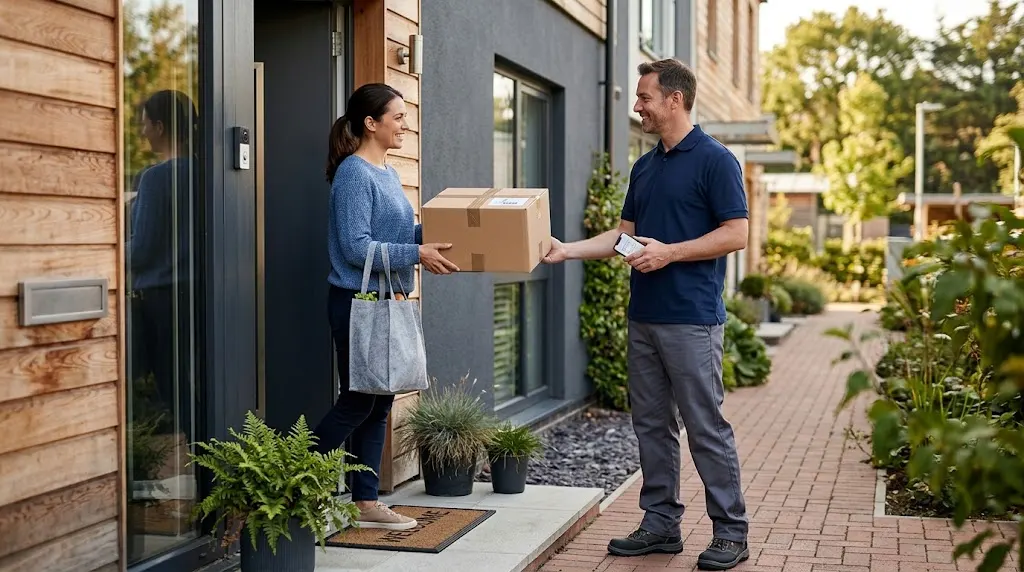
However, not every delivery service works the same way. Delivery speed, service areas, fees, tracking, minimum order requirements, return policies, and product availability can vary considerably.
This guide explains how direct home delivery works, the major types of delivery services, their benefits and limitations, and what consumers and businesses should consider before choosing a delivery option.
What Are Direct Home Delivery Services?
Direct home delivery is a fulfillment model in which a product or service is delivered to a customer’s residential address rather than requiring the customer to collect it from a physical location.
The process can be simple: a customer chooses an item, places an order, provides a delivery address, pays when required, and waits for the order to arrive.
Behind that simple experience, however, several steps may take place. The business needs to receive and process the order, prepare the package, assign or arrange transportation, provide delivery instructions, and complete the final handoff.
That final stage is often called last-mile delivery, and it can have a major effect on customer satisfaction.
Why Direct Home Delivery Has Become So Popular
Convenience is the central reason people choose delivery.
Customers may prefer delivery because they have limited time, do not have convenient transportation, want to avoid crowded stores, are caring for children or family members, work from home, or simply prefer ordering from their phone or computer.
Modern consumers have also become accustomed to tracking orders, receiving estimated delivery windows, and getting notifications when an order is on its way.
For businesses, this creates an opportunity to make the purchasing process easier from beginning to end.
Types of Direct Home Delivery Services
Home delivery covers many different industries. The service model depends heavily on what is being delivered and how quickly the customer needs it.
Grocery Delivery
Grocery delivery allows customers to order food, beverages, household products, and other essentials without visiting a supermarket.
Customers may select specific delivery windows or, where available, choose faster delivery options.
One important consideration is substitution. If a selected product is unavailable, the service may offer a replacement or refund according to its policy.
Restaurant and Meal Delivery
Restaurant delivery allows customers to order prepared meals through a restaurant’s own system or a third-party platform.
Speed and food handling are particularly important because the product is perishable and the customer generally expects it to arrive ready to eat.
Retail Product Delivery
Retailers can ship clothing, electronics, household goods, personal-care products, furniture, and countless other products directly to customers.
Retail delivery can range from small parcels that arrive through standard carriers to large-item delivery requiring specialized transportation.
Prescription and Healthcare-Related Delivery
Some pharmacies and healthcare organizations offer delivery for eligible prescriptions and healthcare products.
Because healthcare deliveries can involve sensitive information, temperature requirements, controlled products, or identity verification, customers should follow the provider’s specific instructions.
Delivery should not be confused with professional home healthcare. For example, Tanner Home Health Services involves skilled healthcare services delivered to eligible patients at home rather than simply delivering a product to a residential address.
Subscription Delivery
Subscription services automatically send products according to a recurring schedule.
Common examples include household supplies, pet products, personal-care items, coffee, food products, and other frequently purchased goods.
Subscriptions can be convenient, but customers should understand renewal dates, cancellation policies, billing schedules, and how often products are shipped.
Same-Day Delivery
Same-day delivery is designed for customers who need an order quickly.
Availability is usually dependent on inventory, location, order time, delivery capacity, and the business’s service area.
Scheduled Delivery
Scheduled delivery allows customers to select a preferred delivery date or time window.
This option can be useful for large household items, groceries, recurring orders, or situations where someone needs to be available to receive the package.
How Direct Home Delivery Works
Although individual companies use different systems, most direct delivery processes follow a similar sequence.
Step 1: Choose the Product or Service
The customer selects the desired item through a website, mobile application, phone order, or another ordering channel.
Step 2: Enter the Delivery Information
The customer provides an address and, where necessary, additional instructions such as apartment numbers, gate information, preferred drop-off locations, or contact details.
Step 3: Confirm the Order
The customer reviews the items, delivery fee, taxes, estimated arrival time, and other applicable charges before completing the purchase.
Step 4: Order Fulfillment
The business prepares the order. Depending on the company, products may come from a warehouse, retail store, restaurant, pharmacy, distribution center, or another fulfillment location.
Step 5: Transportation
The order is assigned to a delivery driver, courier, postal service, or logistics provider.
Step 6: Final Delivery
The package or order reaches the customer’s address. Some deliveries require a signature or direct handoff, while others can be left in an approved location.
Benefits of Direct Home Delivery
Convenience
The biggest advantage is obvious: customers do not have to travel to collect the order.
This can save time and simplify routine purchases.
Time Savings
Delivery can eliminate travel time, parking, checkout lines, and the effort required to carry purchases home.
Accessibility
Home delivery can be particularly useful for people who have mobility limitations, transportation challenges, busy schedules, or other circumstances that make shopping in person difficult.
Greater Product Access
Online ordering can expose customers to a wider selection than they may find at a nearby physical store.
Order Tracking
Many modern delivery services provide tracking information so customers can monitor the progress of an order.
Flexible Purchasing
Customers can often place orders outside traditional store hours, depending on the retailer or service provider.
Benefits for Businesses
Direct delivery is not only valuable to customers. It can also become an important business channel.
Reach Customers Beyond the Store
A physical location limits how far customers are willing to travel. Delivery can expand a company’s practical service area.
Create Additional Sales Opportunities
Customers may purchase more frequently when ordering is simple and convenient.
Improve Customer Experience
A smooth delivery process can become part of the overall customer experience.
ZenithNote’s article on customer satisfaction and business growth explores why businesses should pay attention to the complete customer experience rather than focusing only on the initial transaction.
Build Customer Loyalty
Reliable delivery can give customers another reason to return to the same business.
Collect Useful Operational Data
Digital delivery systems can provide information about order frequency, delivery times, popular products, customer locations, and recurring service problems.
What Makes a Good Home Delivery Experience?
Convenience alone does not guarantee customer satisfaction.
A strong delivery experience usually combines several factors:
- Accurate orders
- Clear delivery pricing
- Realistic delivery estimates
- Reliable tracking
- Professional delivery personnel
- Secure packaging
- Simple communication
- Reasonable customer support
- Clear return or refund procedures
If a company promises delivery within a particular window, it should make a reasonable effort to meet that promise. If delays occur, customers should be informed rather than left guessing.
Delivery Speed vs. Delivery Cost
Faster delivery is not always the best choice.
Customers should consider whether they actually need an order immediately or whether a lower-cost standard delivery option is sufficient.
For routine household purchases, paying extra for same-day delivery may provide little practical value. For urgent products or time-sensitive needs, however, the additional cost may be worthwhile.
The best option depends on urgency, budget, product type, and availability.
What Are Delivery Fees?
Delivery fees compensate the business or logistics provider for transportation and fulfillment costs.
Depending on the service, customers may encounter:
- Flat delivery fees
- Distance-based charges
- Variable delivery fees
- Same-day surcharges
- Small-order fees
- Oversized-item fees
- Subscription delivery charges
Always review the complete order total before checkout rather than focusing only on the product price.
How to Choose the Right Direct Delivery Service
Not every delivery provider is equally suitable for every purchase.
Check the Service Area
First confirm that the company delivers to your address.
Compare Delivery Times
Look at the actual estimated delivery window instead of assuming that every order qualifies for fast delivery.
Review Fees
Compare delivery charges, service fees, minimum-order requirements, and other additional costs.
Read Customer Reviews Carefully
Reviews can reveal recurring issues such as late deliveries, damaged products, poor communication, or difficult refunds.
Check the Return Policy
Understand what happens if the wrong product arrives or the customer changes their mind.
Look for Tracking
Tracking can provide greater visibility and make it easier to plan around an expected delivery.
Delivery Tracking and Notifications
Digital tracking has become an important part of modern home delivery.
Customers may receive notifications when an order is:
- Confirmed
- Prepared
- Dispatched
- Out for delivery
- Delivered
Some services provide more detailed information, including estimated arrival windows or live driver locations.
However, tracking information is still an estimate in many situations. Traffic, weather, order volume, vehicle problems, and other operational issues can affect delivery times.
How Businesses Can Improve Home Delivery
Businesses that offer delivery should treat fulfillment as part of their customer experience rather than an afterthought.
Set Realistic Expectations
It is better to promise a realistic delivery window and meet it than to advertise an aggressive estimate that is frequently missed.
Communicate Delays
Customers are generally more understanding when businesses communicate problems honestly and provide updated expectations.
Protect Products During Transportation
Packaging should reflect the type of product being shipped. Fragile, perishable, liquid, or temperature-sensitive products may require specialized handling.
Make Customer Support Easy to Reach
When something goes wrong, customers need a clear way to ask questions or report problems.
This is especially important because delivery issues can affect the customer’s entire perception of the business.
Use Technology Carefully
Automation can help with tracking, notifications, order processing, and routing, but customers should still have a practical way to receive human assistance when necessary.
Common Problems With Home Delivery
Even well-designed delivery systems can encounter problems.
Late Deliveries
Traffic, weather, high demand, staffing issues, and incorrect estimates can all cause delays.
Damaged Products
Products can be damaged during handling or transportation, particularly when packaging is inadequate.
Incorrect Orders
A customer may receive a different product, quantity, size, or variation than ordered.
Missing Items
Large or multi-item orders may occasionally arrive incomplete.
Delivery to the Wrong Address
Incorrect address information or driver mistakes can result in misdirected deliveries.
Unclear Delivery Instructions
Apartment complexes, gated communities, offices, and multi-unit buildings can create additional challenges when delivery instructions are incomplete.
What Should You Do If a Delivery Goes Wrong?
Start by checking the order confirmation and tracking information.
If the package is marked delivered but cannot be found, check the designated delivery area and ask household members or building staff whether someone accepted it.
If the order is damaged, incorrect, or incomplete, document the problem and contact the business or delivery provider according to its support procedure.
Keep receipts, order numbers, photographs, and relevant communication until the issue has been resolved.
Home Delivery and Customer Trust
Customers judge a delivery company by more than whether a package arrives.
They also consider whether the company was honest about timing, whether the order was accurate, whether communication was clear, and how the business responded when something went wrong.
That is why reliable fulfillment can become a competitive advantage.
As ZenithNote’s customer satisfaction guide explains, businesses build trust when expectations and reality consistently match.
Home Delivery and Accessibility
Delivery can make everyday purchases more accessible to people who face transportation or mobility challenges.
It can also help people recovering at home or caring for another family member.
However, accessibility depends on the delivery provider. Customers may need to confirm whether drivers can bring items to a particular entrance, whether signature requirements can be accommodated, and whether the service delivers to apartments or other specific locations.
Home Delivery for Older Adults
Older adults may benefit from delivery for groceries, meals, household essentials, and other routine purchases.
For families supporting an older relative, recurring delivery can reduce the number of errands required while helping maintain a regular supply of necessary items.
When delivery involves healthcare products or prescriptions, families should follow the relevant provider’s instructions and avoid making assumptions about storage or medication handling.
Home Delivery for Busy Families
Parents and caregivers often have limited time for routine shopping.
Home delivery can reduce the number of errands and allow households to schedule purchases around work, school, childcare, and other responsibilities.
Recurring orders can be particularly useful for products that households purchase regularly.
Home Delivery for Businesses
Businesses can also use direct delivery to serve customers more efficiently.
Restaurants, pharmacies, grocery stores, retailers, florists, manufacturers, and specialty businesses can all use delivery models appropriate to their products.
Businesses should determine whether to handle deliveries internally or use an outside logistics provider. The right decision depends on order volume, geography, product requirements, staffing, technology, and cost.
In-House Delivery vs. Third-Party Delivery
Both models have advantages.
In-House Delivery
With in-house delivery, the business controls its drivers, delivery procedures, customer communication, and often the entire customer experience.
This can provide greater control but also requires investment in vehicles, staffing, insurance, scheduling, and management.
Third-Party Delivery
A third-party provider handles some or all transportation responsibilities.
This can reduce operational complexity, but the business may have less control over the final customer interaction and may pay service or delivery fees.
The best model depends on the business’s scale and priorities.
The Future of Direct Home Delivery
Delivery services continue to evolve as consumers become more comfortable ordering through websites and mobile applications.
Businesses are investing in better inventory systems, route optimization, delivery tracking, automated notifications, and fulfillment technology.
The underlying goal remains simple: make it easier for customers to receive what they need while controlling costs and maintaining reliable service.
Future improvements are likely to focus not only on speed but also on accuracy, transparency, flexibility, and more efficient delivery operations.
Frequently Asked Questions About Direct Home Delivery Services
What are direct home delivery services?
They are services that deliver products or eligible services directly to a customer’s residential address rather than requiring in-person collection.
What can be delivered directly to a home?
Depending on the provider, customers can receive groceries, restaurant meals, retail products, household supplies, prescriptions, subscriptions, furniture, and many other products.
Is home delivery more expensive?
It can be. Some services charge delivery or service fees, while others offer free delivery above a minimum order or through a subscription. Compare the complete checkout price before ordering.
What is same-day delivery?
Same-day delivery means an eligible order is delivered on the same calendar day it is placed, subject to the provider’s cutoff times, inventory, service area, and delivery capacity.
Is home delivery safe?
Most ordinary home deliveries are designed to be safe, but customers should follow provider instructions, protect sensitive information, and use secure delivery locations where appropriate.
Can I track a home delivery?
Many delivery services provide tracking, although the amount of information available varies by provider.
What happens if my delivery is late?
Check the latest tracking information first. If the delay exceeds the provider’s stated window, contact customer support and keep your order details available.
What if my order arrives damaged?
Document the damage and contact the seller or delivery provider as soon as possible. Follow its replacement, refund, or claims procedure.
Final Thoughts
Direct home delivery services have become an important part of modern shopping because they make everyday purchasing more convenient, flexible, and accessible. From groceries and meals to household products, subscriptions, retail goods, and eligible healthcare products, delivery can remove many of the practical barriers associated with traditional shopping.
The best delivery experience is not necessarily the fastest one. Reliability, accurate orders, transparent fees, useful tracking, secure handling, and responsive customer service can matter just as much.
For consumers, the smartest approach is to compare the complete cost and service terms before ordering. For businesses, successful delivery requires more than simply putting products into a vehicle. It requires realistic promises, efficient fulfillment, good communication, and a customer-focused approach from checkout through final delivery.
When these elements work together, direct home delivery can turn a routine purchase into a genuinely convenient customer experience.