
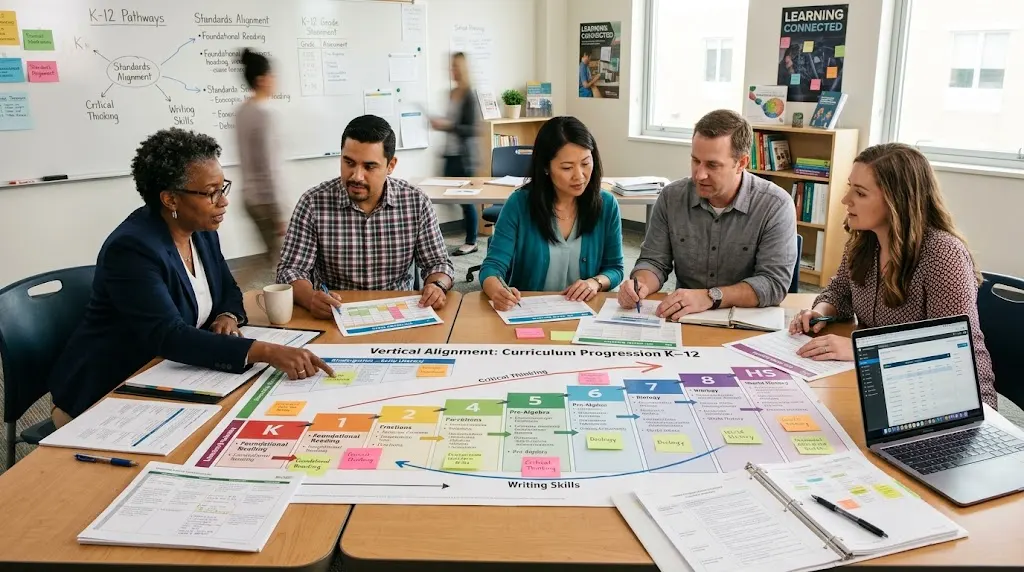
This guide explains what vertical alignment means, why it matters, how schools can implement it, the role teachers play, common challenges, and practical ways technology can support the process.
What Is Vertical Alignment in Education?
Vertical alignment in education is the deliberate sequencing of knowledge, skills, standards, instruction, and assessment across grade levels or courses. The goal is to make sure learning builds progressively rather than occurring as a collection of disconnected lessons.
For example, a student might learn basic fractions in elementary school, apply fractions to ratios and proportional reasoning in later grades, and eventually use those concepts when studying algebra, statistics, or more advanced mathematics. Each stage should build on the knowledge established earlier.
A vertically aligned curriculum therefore asks an important question at every stage: What foundation do students need before they can successfully master the next level?
This approach is closely connected to the idea of learning progressions. Research on learning progressions describes them as pathways through which student knowledge and skills become increasingly sophisticated over time. [Explore the IES research on learning progressions](https://ies.ed.gov/use-work/awards/learning-progressions-middle-school-science-instruction-and-assessment?utm_source=chatgpt.com)
Vertical Alignment vs. Horizontal Alignment
Vertical and horizontal alignment address different but complementary problems.
- Vertical alignment focuses on progression across grade levels, courses, or stages of learning.
- Horizontal alignment focuses on consistency within the same grade level, subject, or instructional stage.
- Instructional alignment connects intended learning goals with what teachers actually teach and what students are asked to demonstrate.
For example, fifth-grade teachers may use horizontal alignment to maintain consistent expectations across classrooms, while vertical alignment ensures that fifth-grade mathematics prepares students for the concepts they will encounter in sixth grade.
A strong system needs both. Consistency within a grade does not solve problems between grades, and a carefully sequenced curriculum can still produce inconsistent experiences if teachers at the same grade level are working toward different expectations.
Why Is Vertical Alignment Important?
The main purpose of vertical alignment is to create continuity in learning. Students should be able to carry useful knowledge and skills from one academic stage into the next without unnecessary repetition or unexplained jumps in difficulty.
1. Reduces Learning Gaps
When grade-level teams understand what was taught previously and what comes next, they can identify missing prerequisites more effectively. This can help schools address foundational weaknesses before students encounter increasingly complex material.
2. Limits Unnecessary Repetition
Without coordination, different teachers may spend substantial instructional time covering the same material while other important concepts receive insufficient attention. Curriculum mapping can reveal where content is repeated, missing, or introduced too early.
3. Creates Clearer Learning Expectations
Students benefit when expectations become progressively more challenging but remain understandable. A well-sequenced curriculum gives teachers a clearer picture of what mastery should look like at each stage.
4. Supports Student Transitions
Moving from elementary school to middle school or from middle school to high school can involve major changes in academic expectations. Vertical alignment can make those transitions more manageable by ensuring that the skills students need have been deliberately developed beforehand.
5. Strengthens Instruction and Assessment
Alignment is not limited to curriculum documents. Assessments should provide evidence that students are developing the intended knowledge and skills. Research on standards alignment emphasizes the relationship among standards, curriculum, instruction, and assessment. [Review ERIC’s standards-alignment resource](https://eric.ed.gov/?id=ED588503&utm_source=chatgpt.com)
Key Components of Effective Vertical Alignment
Successful vertical alignment requires more than creating a spreadsheet of standards. Schools need a coordinated system that connects curriculum decisions, teaching practices, assessments, and professional collaboration.
Curriculum Mapping
Curriculum mapping gives educators a visual overview of what students learn throughout their academic journey. Teams can examine standards, units, essential skills, prerequisites, and expected outcomes across multiple grades.
A useful curriculum map should identify:
- Essential knowledge and skills
- Prerequisite concepts
- When major concepts are introduced
- When those concepts are reinforced
- When students are expected to demonstrate mastery
- Where content may be duplicated or missing
Standards Alignment
Academic standards provide expectations for what students should know and be able to do. Vertical alignment connects those expectations across multiple grades so they form a logical progression rather than separate lists.
State education systems demonstrate this principle through tools that organize standards and learning progressions across grade levels. The Texas Education Agency, for example, provides vertical alignment resources spanning early learning through elementary grades. [View the Texas Education Agency’s vertical alignment resources](https://tea.texas.gov/educators/early-childhood-education/educator-resources/vertical-alignments?utm_source=chatgpt.com)
Assessment Alignment
Assessments should measure the knowledge and skills students are expected to develop. If instruction emphasizes analysis but assessments primarily reward memorization, the system is not fully aligned.
Schools should examine whether formative assessments, classroom assignments, projects, benchmark assessments, and larger-scale tests reflect the intended progression.
Instructional Consistency
Vertical alignment does not mean every teacher must use identical teaching methods. Instead, instruction should reflect a shared understanding of the skills and concepts students are developing.
Teachers can maintain flexibility in how they teach while still ensuring that important concepts are introduced, practiced, reinforced, and extended in an appropriate sequence.
Teacher Collaboration
Cross-grade collaboration is one of the most important practical elements of vertical alignment. Teachers need opportunities to discuss curriculum expectations, student work, assessment results, instructional challenges, and prerequisite skills.
Professional learning communities can provide a structure for these conversations, particularly when teams examine actual student evidence rather than relying only on curriculum documents.
How Vertical Alignment Works Across Grade Levels
Consider a simplified mathematics progression.
- Elementary: Students develop number sense, operations, fractions, and basic mathematical reasoning.
- Middle school: Students connect arithmetic concepts with ratios, proportional relationships, expressions, equations, and more abstract reasoning.
- High school: Students apply those foundations to algebra, functions, geometry, statistics, and advanced mathematical problem-solving.
The exact sequence varies by state, district, curriculum, and subject. The important principle is that later learning should build on meaningful prior knowledge.
Science can follow a similar progression. Students might begin by observing and describing phenomena, then develop skills in measurement and evidence, and later use increasingly sophisticated models, explanations, and scientific reasoning.
The Institute of Education Sciences has supported research into learning progressions that connect standards, instruction, and assessment, including work examining how students develop increasingly sophisticated scientific understanding. [See the IES learning-progressions research](https://ies.ed.gov/use-work/awards/learning-progressions-middle-school-science-instruction-and-assessment?utm_source=chatgpt.com)
The Role of Teachers in Vertical Alignment
Teachers are central to making vertical alignment work because curriculum documents alone cannot guarantee coherent learning experiences.
Teachers can support alignment by reviewing previous and upcoming expectations, identifying prerequisite skills, examining student work, communicating with colleagues, and adjusting instruction when evidence shows that students need additional support.
For example, a sixth-grade teacher who notices that students struggle with fraction operations may need to determine whether the issue is a temporary instructional need or a broader prerequisite gap. Communication with previous grade-level teachers can provide valuable context.
Likewise, high school teachers can communicate backward to middle school teams about the skills students need for future coursework. This creates a two-way conversation rather than a one-directional handoff.
Common Challenges With Vertical Alignment
Implementing vertical alignment can be difficult, particularly in large school systems where teachers work across many grade levels and departments.
Limited Collaboration Time
Teachers already manage planning, instruction, grading, communication, and student support. Without protected collaboration time, vertical planning can become an occasional task instead of a sustained practice.
Different Interpretations of Standards
Two teachers may interpret the same standard differently. Teams therefore need shared definitions of essential skills, expected depth, and evidence of mastery.
Curriculum Overload
Schools may attempt to cover too many standards without determining which concepts require deeper treatment. Vertical alignment works best when teams identify essential learning rather than simply adding more content to curriculum maps.
Student Differences
Students do not progress at identical rates. A vertically aligned system must provide flexibility for students who need intervention, additional practice, acceleration, or different pathways to demonstrate understanding.
Resistance to Change
Teachers may be understandably cautious when alignment initiatives are introduced without sufficient time, support, or explanation. Successful implementation depends on treating educators as collaborators in the process rather than simply asking them to adopt another administrative requirement.
How Technology Can Support Vertical Alignment
Technology can make vertical alignment easier to organize and monitor, particularly when schools need to manage large amounts of curriculum and assessment information.
Digital curriculum-mapping systems can help educators see where standards appear across grade levels. Learning management systems can provide information about assignments and student progress, while assessment platforms can help identify patterns that deserve further investigation.
Data dashboards can also help administrators compare progress across grades and subjects. However, technology should support professional judgment rather than replace it. A data point can identify a possible problem, but teachers still need to understand why students are struggling and what instructional response is appropriate.
A Practical Process for Implementing Vertical Alignment
Schools can begin with a focused subject or grade-band project instead of attempting to redesign the entire curriculum at once.
- Define the desired learning outcomes. Identify the knowledge and skills students should develop by the end of each stage.
- Map existing curriculum. Document when major concepts are introduced, practiced, reinforced, and assessed.
- Identify gaps and redundancies. Look for missing prerequisites, unnecessary repetition, and abrupt jumps in complexity.
- Review assessments. Determine whether assessments actually measure the intended knowledge and skills.
- Bring teachers together. Use cross-grade conversations to compare expectations and student evidence.
- Revise instruction. Adjust units, lessons, materials, or pacing where evidence indicates a need.
- Monitor results. Continue reviewing student work and assessment evidence to determine whether the progression is functioning as intended.
This process should be iterative. Alignment is not a one-time document that sits on a shared drive; it should evolve as educators learn more about student needs and curriculum effectiveness.
Vertical Alignment and Student Success
The strongest argument for vertical alignment is its potential to make learning more coherent for students. When foundational knowledge is deliberately developed and later instruction builds on it, students are more likely to understand why new material matters and how it connects with what they already know.
That does not mean alignment automatically guarantees higher test scores or eliminates every learning gap. Student achievement depends on many factors, including instructional quality, attendance, resources, school climate, student needs, and family and community circumstances.
Instead, vertical alignment provides an important structural foundation. It gives educators a shared framework for thinking about progression and creates opportunities to identify problems before they become larger barriers to learning.
What Effective Vertical Alignment Looks Like
A well-aligned school system typically has several characteristics:
- Teachers understand the skills students should bring from previous grades.
- Curriculum sequences become progressively more complex.
- Major concepts are intentionally reinforced rather than randomly repeated.
- Assessments reflect the intended learning outcomes.
- Teachers regularly discuss student evidence across grade levels.
- Intervention and enrichment are incorporated into the broader learning progression.
- Curriculum decisions are reviewed and refined over time.
These characteristics help create a learning experience in which each academic stage has a clear relationship to the stages before and after it.
Frequently Asked Questions About Vertical Alignment in Education
What is an example of vertical alignment in education?
A common example is mathematics instruction in which students learn foundational number concepts in elementary grades, build proportional and algebraic reasoning in middle school, and apply those foundations to algebra and functions in high school.
What is the purpose of vertical alignment?
The purpose is to create a logical progression of learning so students can build new knowledge and skills on meaningful foundations developed in earlier grades.
What is the difference between vertical and horizontal alignment?
Vertical alignment connects learning across grades or courses, while horizontal alignment promotes consistency among classrooms or subjects operating at the same academic level.
How does curriculum mapping support vertical alignment?
Curriculum mapping gives educators a structured view of when concepts are introduced, reinforced, extended, and assessed. This makes gaps, duplication, and sequencing problems easier to identify.
Can technology improve vertical alignment?
Technology can support curriculum mapping, assessment analysis, progress tracking, and collaboration. It is most useful when educators combine digital information with professional judgment and knowledge of individual students.
Final Thoughts
Vertical alignment in education helps schools move from disconnected grade-level instruction toward a more coherent learning progression. By connecting curriculum, standards, teaching, assessment, and teacher collaboration, schools can create clearer pathways from foundational knowledge to more advanced learning.
The process requires time and collaboration, but it does not need to begin with a complete curriculum overhaul. Schools can start with one subject, grade band, or priority skill, map the existing progression, identify gaps, review assessments, and make targeted improvements.
When alignment becomes an ongoing professional practice rather than a one-time project, educators gain a clearer understanding of how today’s instruction contributes to tomorrow’s learning. That continuity can make academic transitions more purposeful and help students approach increasingly complex work with stronger foundations.
For additional perspective on education systems and institutional change, readers can also explore ZenithNote’s higher education change management article and its guide to the education code 48900.