
Important: This article provides general educational information about California law and is not legal advice. School discipline can involve additional state laws, district policies, procedural requirements, and individual circumstances.
What Is California Education Code 48900?
California Education Code Section 48900 is part of the state’s statutory framework for suspension and expulsion in public schools. It provides that a student generally cannot be suspended or recommended for expulsion unless the principal or district superintendent determines that the student committed an act covered by the statute.
The current section is located within Chapter 6 of Part 27 of the Education Code, under Article 1, which addresses suspension or expulsion. The statute identifies categories of conduct ranging from physical violence and dangerous objects to theft, certain substance-related conduct, bullying, hazing, and other specified behavior. Read the current California Education Code Section 48900 for the complete statutory language.
What Behaviors Can Fall Under Section 48900?
Section 48900 contains multiple subdivisions covering different types of conduct. The exact legal consequences depend on the specific facts, the student’s grade level, related statutes, and applicable school procedures.
Physical Injury or Violence
Section 48900 addresses causing, attempting to cause, or threatening to cause physical injury, as well as willfully using force or violence against another person except in self-defense.
Importantly, California has adopted grade-level restrictions affecting when suspension may be used for certain physical-injury conduct. The current statute includes specific provisions for kindergarten through grade 12 and contains dates affecting how some provisions operate.
Weapons and Dangerous Objects
Section 48900 also addresses possession, sale, or furnishing of firearms, knives, explosives, or other dangerous objects, subject to the statutory exceptions and requirements.
Controlled Substances, Alcohol, and Intoxicants
Students may fall within Section 48900 when they unlawfully possess, use, sell, furnish, or are under the influence of specified controlled substances, alcoholic beverages, or intoxicants.
The law also contains an important support-oriented provision: a student who voluntarily discloses controlled-substance or alcohol use to seek help through services or supports is not to be suspended solely because of that disclosure.
Robbery or Extortion
Committing or attempting to commit robbery or extortion is another category identified in Section 48900.
Property Damage
Causing or attempting to cause damage to school property or private property can also fall under the statute.
Theft
Stealing or attempting to steal school property or private property is included as a disciplinary ground.
Tobacco and Nicotine Products
The statute addresses possession or use of tobacco and products containing tobacco or nicotine. It also contains an exception concerning a student’s own prescription products and protections for certain voluntary disclosures made to seek help.
Obscene Acts, Profanity, and Vulgarity
Section 48900 includes committing an obscene act or engaging in habitual profanity or vulgarity among the conduct that can be addressed under the statute.
Drug Paraphernalia
Unlawful possession or certain attempts to offer, arrange, negotiate, or sell drug paraphernalia are also addressed.
Willful Defiance and Disruption
One of the most important areas for parents to understand is Section 48900(k), which concerns disruption of school activities or willful defiance of valid authority.
The current statute places significant restrictions on suspending students for these acts. Kindergarten through grade 5 students generally cannot be suspended for conduct covered by this subdivision, and the subdivision does not provide grounds for expulsion recommendations for students in kindergarten through grade 12. Additional restrictions apply to grades 6–8 and 9–12, with provisions scheduled to become inoperative on July 1, 2029.
California Department of Education guidance also explains the state’s movement toward reducing suspensions for willful defiance and using supportive approaches instead.
Receiving Stolen Property
Knowingly receiving stolen school property or private property is another listed category.
Imitation Firearms
The statute addresses possession of an imitation firearm when the replica is sufficiently similar to an existing firearm that a reasonable person could conclude it is a firearm.
Sexual Assault or Sexual Battery
Section 48900 also identifies committing or attempting to commit specified forms of sexual assault or committing sexual battery as disciplinary grounds.
Witness Harassment or Intimidation
Harassing, threatening, or intimidating a student who is a complaining witness or witness in a school disciplinary proceeding can fall under the statute when the conduct is intended to prevent testimony, retaliate against the witness, or both.
Hazing
Section 48900 covers hazing when it involves an initiation or preinitiation method that is likely to cause serious bodily injury or personal degradation or disgrace resulting in physical or mental harm. Athletic events and school-sanctioned events are excluded from the statutory definition.
Bullying
Bullying is another significant category under Section 48900. The statute defines bullying broadly enough to include severe or pervasive physical or verbal acts or conduct, including certain written or electronic communications.
The law considers whether the conduct can reasonably be expected to place a student in fear of harm, cause a substantially detrimental effect on physical or mental health, substantially interfere with academic performance, or substantially interfere with participation in or benefit from school services, activities, or privileges.
Does California Education Code 48900 Apply to Online Conduct?
Yes, certain electronic conduct can be relevant to Section 48900. The statute’s bullying provisions include electronic acts involving communications such as messages, texts, sounds, videos, images, and certain social-network activity.
The law recognizes concepts such as burn pages, credible impersonation, false profiles, and cyber sexual bullying within its definition of electronic acts. It also states that an electronic act does not become pervasive conduct solely because it was transmitted over the internet or remains posted online.
This distinction matters because online student behavior can raise complicated questions about context, connection to school, impact on students, and the specific statutory requirements.
When Does Section 48900 Apply to Conduct Outside School?
A common misconception is that Section 48900 automatically applies to any student behavior occurring anywhere. The statute establishes a connection-to-school requirement.
Under subdivision (s), a student generally cannot be suspended or expelled for conduct listed in Section 48900 unless the act is related to a school activity or school attendance. The statute specifically identifies several situations in which that connection may exist:
- While on school grounds
- While going to or coming from school
- During lunch, whether on or off campus
- During, or while going to or coming from, a school-sponsored activity
This school-connection requirement can be particularly important in cases involving transportation, extracurricular activities, lunch periods, and electronic conduct.
What Is the Difference Between Suspension and Expulsion?
Suspension is a temporary removal from school. Expulsion is a substantially more serious disciplinary action that removes a student from the district’s regular educational program under the applicable legal framework.
Section 48900 identifies conduct that can provide grounds for suspension or a recommendation for expulsion, but it should not be interpreted as meaning that every listed violation automatically results in expulsion.
The California Department of Education explains that expulsion is the most serious disciplinary action and that the governing school board, rather than simply an individual administrator, imposes an expulsion. California law also provides specific procedural requirements for expulsion proceedings.
Are Students Always Suspended for a First Offense?
No. Section 48900 must be read together with related provisions governing other means of correction and the circumstances under which suspension may be used.
California Education Code Section 48900.5 generally emphasizes using other means of correction before suspension, subject to statutory exceptions. California Department of Education guidance describes approaches such as additional academic support, restorative justice practices, trauma-informed practices, social-emotional learning, and positive behavioral interventions and support.
This means a school discipline decision should not be understood simply as a mechanical sequence of “violation equals suspension.” Administrators must consider the applicable provisions, the conduct involved, the student’s circumstances, and the available corrective approaches.
California’s Approach to Alternatives to Suspension
Recent California education policy places considerable emphasis on keeping students connected to instruction when appropriate.
Section 48900(v) encourages administrators to provide alternatives to suspension or expulsion using research-based approaches that are age appropriate and designed to address the specific behavior. Section 48900(w) also identifies Multi-Tiered System of Supports, restorative justice, trauma-informed practices, social-emotional learning, and schoolwide positive behavioral interventions and support as approaches that can help students develop skills and repair harm.
The California Department of Education similarly describes suspension as a measure that should generally be used only after other means of correction have failed, subject to specified exceptions.
Can a Student Be Suspended for Being Absent or Tardy?
Section 48900 expressly states that suspension or expulsion cannot be imposed solely because a student is truant, tardy, or otherwise absent from school activities.
This distinction is important for families dealing with attendance concerns. Attendance problems can trigger other school interventions and legal processes, but absence alone is not a standalone basis for discipline under Section 48900.
What Should Parents Do After a Section 48900 Discipline Notice?
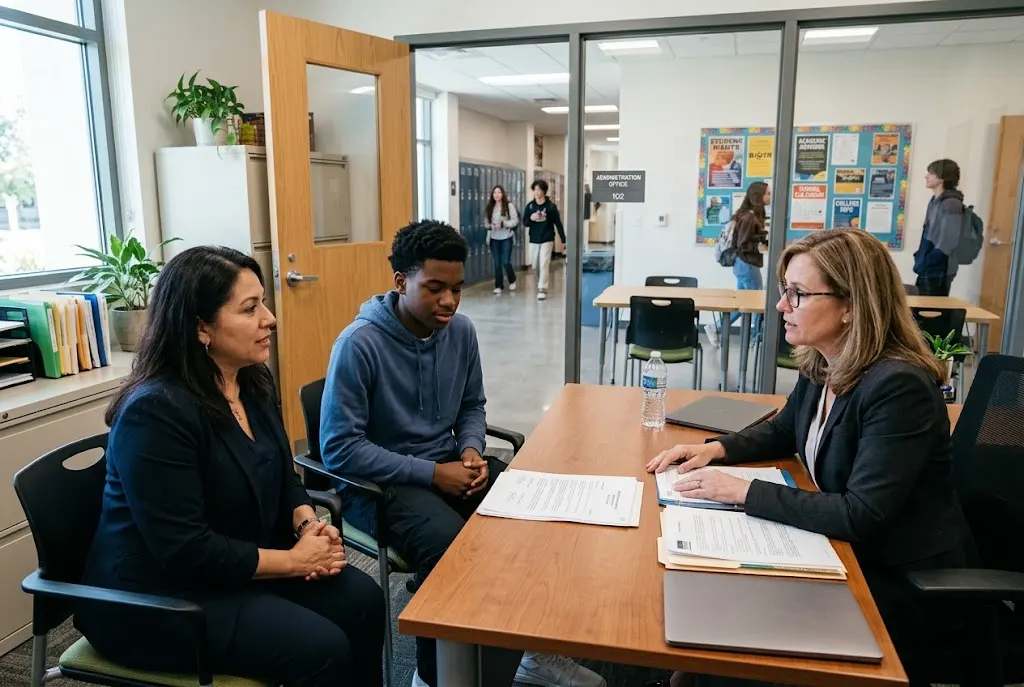
Parents should begin by carefully reviewing the school’s written notice and identifying the specific conduct cited. A vague understanding of “being disciplined under 48900” is not enough to determine what happened or what options may be available.
1. Ask Which Subdivision Applies
Section 48900 contains multiple subdivisions. Ask the school which specific provision is being relied upon and what conduct the school believes satisfies that provision.
2. Request the Relevant Documentation
Keep copies of disciplinary notices, communications, assignments, meeting records, and other relevant documents. A clear timeline can help parents understand how the school reached its decision.
3. Understand the School’s Process
Ask what disciplinary process applies, what the duration of the suspension is if one has been imposed, whether a meeting or conference is available, and what rights or review procedures apply.
4. Consider the Student’s Educational Needs
If the student receives special education services or has other educational needs, parents should ask whether additional legal or procedural protections apply. Discipline involving students with disabilities can involve requirements beyond the general Section 48900 framework.
5. Ask About Alternatives
Because California law emphasizes alternatives to exclusionary discipline in appropriate circumstances, parents can ask the school whether restorative practices, counseling, behavioral supports, academic interventions, or other corrective measures are available.
What Should Schools Consider When Applying Section 48900?
Schools have an important responsibility to maintain safe and productive learning environments while applying disciplinary rules fairly and consistently.
Administrators should consider:
- The specific conduct involved
- The applicable subdivision of Section 48900
- The student’s grade level
- The connection between the conduct and school activity or attendance
- Applicable exceptions and limitations
- Whether other means of correction are required or appropriate
- The student’s educational circumstances
- Available behavioral and academic supports
- Applicable district policies and procedural requirements
California Department of Education resources emphasize behavioral intervention strategies and supports that can help schools address conduct while keeping students engaged in education when appropriate.
Section 48900 and Student Rights
Student discipline does not exist outside the broader framework of student rights. California’s Education Code contains additional provisions governing suspension, expulsion, notifications, hearings, records, and other procedural matters.
For example, California law contains specific procedures for expulsion proceedings, and students facing expulsion have procedural protections. The California Department of Education notes that an administrator’s recommendation is not the same as the governing board’s final expulsion action.
Parents should therefore avoid assuming that a disciplinary recommendation automatically determines the final outcome.
How Section 48900 Relates to School Safety
Student discipline and school safety are closely connected, but effective school safety involves more than punishment.
Schools may need to respond to threats, violence, bullying, harassment, substance-related behavior, or dangerous objects while also considering prevention, intervention, student support, and restoration.
This broader approach is consistent with California’s emphasis on alternatives and Multi-Tiered System of Supports. The goal is not simply to remove a student from school but, when appropriate, to address the behavior and reduce the likelihood of recurrence.
Why Recent Changes Matter to Parents and Educators
California’s student-discipline framework has evolved over time. Restrictions on suspension for willful defiance, limits related to certain lower-grade offenses, and increased emphasis on alternatives mean that older explanations of Section 48900 may no longer accurately describe the current law.
The current statutory text includes restrictions affecting different grade levels and states that several provisions will become inoperative on July 1, 2029. For that reason, parents and educators should check the current statutory language rather than relying on older articles, school-discipline summaries, or social media posts.
Frequently Asked Questions
What is California Education Code 48900?
California Education Code 48900 identifies specific student conduct that may provide grounds for suspension or a recommendation for expulsion in California public schools, subject to the requirements and limitations contained in the law and related provisions.
What are the most common types of conduct covered by Section 48900?
The statute covers multiple categories, including physical injury or violence, dangerous objects, certain controlled substances and alcohol-related conduct, property damage, theft, tobacco or nicotine products, certain disruptive or defiant conduct, imitation firearms, sexual assault or battery, witness intimidation, hazing, and bullying.
Can Section 48900 apply to cyberbullying?
Yes. The bullying provisions address certain electronic acts, including communications and specified social-network activity. The statute also defines several forms of electronic conduct within its bullying framework.
Can a student be suspended for being late to school?
Not solely for being tardy. Section 48900(w) states that suspension or expulsion cannot be imposed solely because a student is truant, tardy, or otherwise absent from school activities.
Does every Section 48900 violation lead to expulsion?
No. Section 48900 identifies conduct that can provide grounds for discipline, while related laws establish when expulsion may be recommended or imposed and what procedures must be followed.
Can parents challenge a school discipline decision?
Depending on the type of disciplinary action, applicable procedures may provide opportunities for conferences, hearings, review, or other forms of challenge. Parents should review the school’s notice and applicable district and state procedures carefully.
Final Thoughts
California Education Code 48900 is a foundational part of California’s student-discipline framework, but understanding it requires more than reading a list of prohibited behaviors. The law establishes specific categories of conduct, limitations based on grade level, a connection-to-school requirement, rules concerning electronic acts and bullying, and an increasing emphasis on alternatives to suspension and expulsion.
For parents, the most useful first step is to identify exactly what conduct and subdivision the school has cited. From there, families can review the applicable disciplinary process, ask about educational and behavioral supports, and determine whether additional procedural protections may apply.
For educators and administrators, Section 48900 should be considered alongside related Education Code provisions, district policies, student rights, and evidence-based approaches to behavior intervention. California’s current framework increasingly emphasizes keeping students engaged in learning while addressing misconduct appropriately.
Because education laws can change, anyone dealing with a specific disciplinary matter should consult the current California statutes, school or district policies, and, where appropriate, a qualified education-law professional.
For broader education topics, readers can also explore ZenithNote’s article on vertical alignment in education and its coverage of higher education change management.