
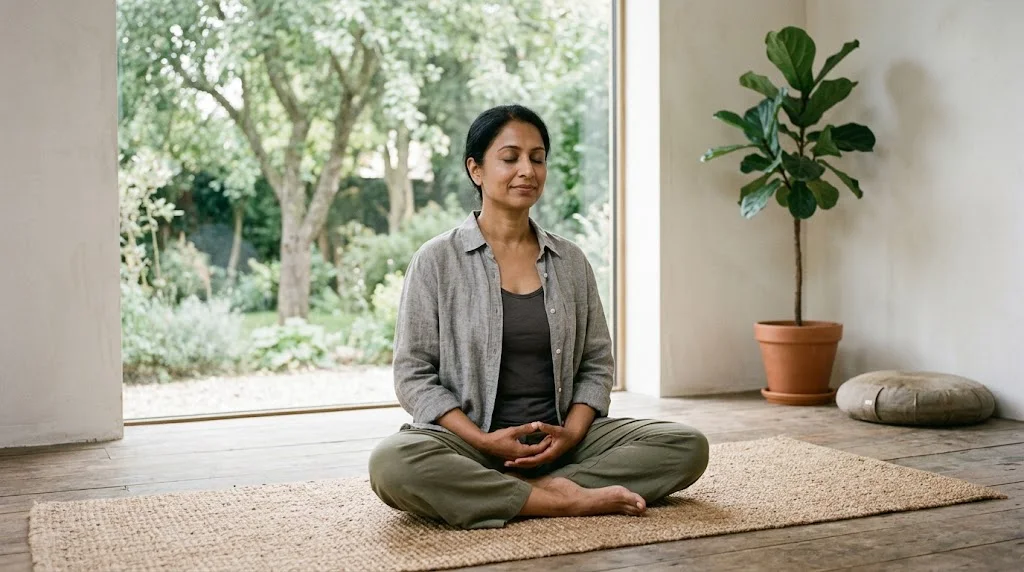
“Yoga is the stilling of the changing states of the mind” is one of the most concise definitions of yoga found in the Yoga Sutras of Patanjali. It appears as Sutra 1.2, yogaś citta-vṛtti-nirodhaḥ, and presents yoga not simply as physical exercise but as a disciplined approach to quieting the fluctuations of the mind.
For modern audiences, yoga is often associated with stretching, balance, flexibility, and physical postures. Those practices can be valuable, but Patanjali’s definition points toward a deeper philosophical purpose: developing greater steadiness, concentration, awareness, and freedom from being constantly carried away by changing thoughts and mental states.
The following sutra adds an important idea: when the changing activity of the mind is stilled, the “seer” abides in its own true nature. This makes mental clarity central to the classical understanding of yoga.
What Does “Yoga Is the Stilling of the Mind” Mean?
The word “stilling” does not necessarily mean forcing the mind to become completely blank. A more useful interpretation is learning to reduce the constant dominance of mental fluctuations so that awareness becomes steadier and clearer.
Human attention is naturally pulled in many directions. A memory can interrupt the present moment. An imagined future can create anxiety. A pleasant thought can become a distraction, while an unpleasant thought can repeatedly occupy attention.
Patanjali’s definition places yoga in the context of learning how to relate differently to these changing states. Instead of automatically identifying with every thought, emotion, memory, or mental image, the practitioner develops greater stability and awareness.
Understanding the Sanskrit Phrase
The Sanskrit phrase yogaś citta-vṛtti-nirodhaḥ is commonly translated as “Yoga is the stilling of the changing states of the mind.” In Edwin Bryant’s translation, citta refers to the mind, vṛtti to a fluctuation or state, and nirodhaḥ to restraint or control.
This short phrase contains the central idea of the first chapter of the Yoga Sutras. Rather than defining yoga primarily as a physical posture, it describes yoga in terms of the relationship between consciousness and mental activity.
The definition also helps explain why traditional yoga includes practices involving concentration, breath regulation, meditation, ethical discipline, and withdrawal of attention from distracting sensory activity.
The Mind Is Constantly Changing
One of the most recognizable features of everyday mental life is change. Thoughts appear and disappear. Emotions rise and fall. Memories return unexpectedly. Plans develop and change. Attention moves between sounds, sensations, conversations, responsibilities, and internal concerns.
Patanjali describes several categories of changing states of mind. These include valid cognition, error, conceptualization or imagination, sleep, and memory. The point is not that every mental activity is inherently bad. Rather, the mind is continually changing, and yoga addresses the practitioner’s relationship with those changes.
This is an important distinction. Yoga does not require someone to stop thinking forever. Instead, classical yoga emphasizes developing the ability to stabilize attention and avoid becoming completely absorbed in every fluctuation.
Why Mental Stillness Matters
A constantly distracted mind can make it difficult to see situations clearly. When attention is repeatedly pulled toward worries, memories, expectations, and reactions, the present moment can become difficult to experience directly.
Mental stillness creates space between an experience and an automatic reaction. That space can make concentration easier and may allow a person to respond more deliberately rather than immediately following every impulse.
This idea is one reason yoga philosophy remains relevant beyond the physical practice of yoga. It addresses a problem familiar to modern life: the difficulty of maintaining attention in an environment filled with information and interruptions.
Yoga Is More Than Physical Postures
Modern yoga classes often emphasize asana, or physical posture. Physical practice can support strength, mobility, balance, body awareness, and relaxation, but the classical Yoga Sutras present yoga as a much broader discipline.
The Yoga Sutras later describe an eight-limbed path that includes ethical restraints, observances, posture, breath regulation, withdrawal of the senses, concentration, meditation, and absorption.
This broader framework shows why reducing yoga to stretching misses much of its philosophical tradition. Physical practice can be one component of a larger system aimed at developing disciplined attention and deeper awareness.
Practice and Dispassion
Patanjali does not present mental steadiness as something achieved through a single moment of inspiration. The text connects the stilling of mental fluctuations with practice and dispassion.
Practice involves repeatedly training the mind to remain established in concentration. Dispassion involves reducing the tendency to become controlled by cravings and attachments.
This combination offers a practical lesson: concentration develops through repetition, while mental freedom develops partly through learning not to chase every desire or reaction.
The tradition emphasizes that practice becomes firmly established through sustained and devoted effort over time.
What Are the “Changing States” of the Mind?
The changing states of the mind can be understood as the many forms mental activity takes throughout the day.
- Thoughts: Ideas, judgments, plans, and interpretations constantly arise.
- Emotions: Happiness, frustration, fear, excitement, sadness, and calm can alter attention.
- Memories: Past experiences can influence how the present is perceived.
- Imagination: The mind can construct situations that have not happened.
- Expectations: Anticipating future outcomes can pull attention away from the present.
- Sensory distractions: Sounds, sights, physical sensations, and environmental changes can interrupt concentration.
Yoga philosophy is concerned with learning to observe these movements without becoming completely identified with them.
Yoga and the Idea of the “Seer”
Sutra 1.3 follows the definition of yoga with the statement that, when the fluctuations are stilled, the seer abides in its own true nature. This introduces one of the central philosophical ideas of Patanjali’s system.
The “seer” can be understood within the classical tradition as the witnessing consciousness that is distinct from the changing activities of the mind. When attention is constantly absorbed in thoughts and emotions, awareness can become identified with those experiences.
Stillness is therefore presented as a way of recognizing a distinction between awareness and the changing contents of mental experience.
How Meditation Relates to Mental Stillness
Meditation provides one of the clearest practical contexts for understanding the phrase.
During meditation, attention may be directed toward a chosen object, such as the breath, a mantra, or another point of concentration. Thoughts may still appear, but the practitioner repeatedly returns attention to the chosen focus.
Over time, this process can develop greater familiarity with the mind’s tendency to wander. The goal is not necessarily to become frustrated whenever a thought appears. Instead, the practice involves noticing distraction and returning attention.
This is consistent with the broader yogic tradition in which concentration and meditation are progressive stages of training attention.
Yoga, Breath, and Attention
Breath practices also have an important place in the classical yoga framework. Patanjali describes pranayama as the regulation of the incoming and outgoing breath and places it within the eight-limbed path.
For contemporary practitioners, conscious breathing can provide a practical anchor for attention. Focusing on the rhythm of breathing can make it easier to notice when the mind has wandered and gently return awareness to the present experience.
Breath-focused practices should nevertheless be approached appropriately, particularly when they involve prolonged breath retention or advanced techniques. Beginners can generally start with simple, comfortable breathing awareness rather than attempting demanding practices without guidance.
Yoga and the Modern Problem of Distraction
The ancient concern with mental fluctuation has an obvious modern parallel.
Phones, notifications, social media, email, streaming services, advertising, and constant digital communication create an environment in which attention is frequently interrupted.
Even when there is no external notification, people can become accustomed to switching rapidly between tasks and sources of information.
The classical yoga concept of stilling mental fluctuations offers a useful philosophical counterpoint: attention is a skill that can be cultivated rather than something that must always be surrendered to whatever appears next.
Simple Ways to Practice Mental Stillness
Begin With a Few Quiet Minutes
Set aside a short period without unnecessary notifications or interruptions. Sit comfortably and allow attention to settle.
Use the Breath as an Anchor
Notice the natural rhythm of breathing. When attention wanders, recognize it without harsh self-judgment and return to the breath.
Reduce Unnecessary Stimulation
Turning off nonessential notifications or creating periods without social media can make sustained attention easier.
Practice Consistently
Regular short sessions are often more realistic than attempting an intense practice occasionally. The principle of sustained practice is central to Patanjali’s teaching.
Observe Without Immediately Reacting
When a thought or emotion appears, notice it before automatically acting on it. This creates an opportunity to develop greater awareness of mental habits.
Stillness Does Not Mean Suppressing Emotions
It is important not to interpret mental stillness as emotional suppression.
A calm mind is not necessarily a mind that never experiences sadness, anger, excitement, fear, or joy. Human emotions are part of ordinary experience.
The deeper yogic idea is concerned with how consciousness relates to changing mental states. Instead of being completely controlled by each emotional fluctuation, the practitioner develops greater steadiness and awareness.
This makes yoga different from simply trying to force yourself to “think positive.” The practice is about cultivating a more stable relationship with the mind rather than demanding that every thought become pleasant.
The Difference Between Relaxation and Yoga Philosophy
Yoga can certainly be relaxing, but relaxation alone does not fully explain the classical definition.
A person may relax physically while the mind continues moving rapidly from one concern to another. Conversely, someone practicing concentration may remain alert and attentive rather than simply becoming sleepy or passive.
The goal described by Patanjali is therefore closer to disciplined clarity than ordinary relaxation. The mind becomes steadier while awareness remains present.
Yoga as a Practice of Attention
At its practical level, the phrase can be understood as a lesson in attention.
Where attention goes repeatedly can shape habits. If attention is constantly pulled toward worry, comparison, distraction, or craving, those patterns can become familiar. If attention is repeatedly brought back to a chosen object, concentration can become more stable.
This is why yoga philosophy places such emphasis on practice. Mental steadiness is not presented as a personality trait possessed by only a few people. It is something cultivated through disciplined repetition.
The related idea that yoga is a journey of the self through the self to the self complements this theme by focusing on yoga as an inward journey rather than merely a physical activity.
Yoga and the Journey Toward Inner Awareness
When the mind becomes less dominated by constant fluctuation, the practitioner can pay closer attention to experience itself.
This inward attention is one reason yoga has remained connected with meditation and contemplative practice. The objective is not simply to perform impressive physical movements but to cultivate a different relationship with thought, perception, desire, and awareness.
Within the classical philosophical framework, this process ultimately points toward recognizing the seer as distinct from the changing states of mind.
Why This Ancient Definition Still Matters
Modern life provides countless opportunities to improve physical fitness, but mental steadiness can be harder to maintain.
People may spend hours consuming information without having much uninterrupted time for reflection. The ability to focus on one task, sit quietly, observe thoughts, or simply experience the present moment can therefore feel increasingly valuable.
Patanjali’s definition of yoga speaks directly to this challenge. Its central question is not how much information a person can consume, but whether the mind can become sufficiently steady to see experience clearly.
Frequently Asked Questions
Who said “Yoga is the stilling of the changing states of the mind”?
The phrase is a translation of Patanjali’s Yoga Sutra 1.2, yogaś citta-vṛtti-nirodhaḥ. Edwin Bryant’s translation renders it as “Yoga is the stilling of the changing states of the mind.”
What does “stilling the mind” mean in yoga?
It refers to reducing the dominance of constantly changing mental activity and developing greater steadiness of attention and awareness. It does not necessarily mean forcing the mind to become completely blank.
Is yoga only about physical exercise?
No. Physical postures are one component of the broader classical yoga tradition. Patanjali’s eight-limbed framework also includes ethical practices, breath regulation, sensory withdrawal, concentration, meditation, and absorption.
How can beginners practice mental stillness?
Beginners can start with a few quiet minutes of comfortable breathing awareness, gently returning attention whenever the mind wanders. Consistency is more important than forcing an advanced practice.
Does yoga mean stopping all thoughts?
Not necessarily. A more useful interpretation is developing a steadier relationship with mental activity so that thoughts and emotions do not automatically control attention.
What is the goal of yoga according to Patanjali?
In the opening sutras, Patanjali defines yoga through the stilling of mental fluctuations and then describes the seer abiding in its own true nature. The broader text develops practices intended to support this process.
Final Thoughts
“Yoga is the stilling of the changing states of the mind” offers a much deeper definition of yoga than the modern image of stretching on a mat.
At the heart of Patanjali’s teaching is the relationship between awareness and the constantly changing activity of the mind. Thoughts, memories, emotions, and perceptions will continue to arise, but disciplined practice can cultivate greater steadiness in how we relate to them.
That makes yoga relevant not only as a physical practice but also as a philosophy of attention. In a world filled with constant stimulation, learning to become still, focused, and aware can be a powerful form of practice.
The journey begins with something simple: noticing where the mind goes, returning attention when it wanders, and gradually learning that we do not have to follow every thought that appears.